
AI-First Product Strategy: When to Build, Buy, or Partner for AI Capabilities
A Three-Lens Framework for Making the Build, Buy, or Partner Decision With Confidence

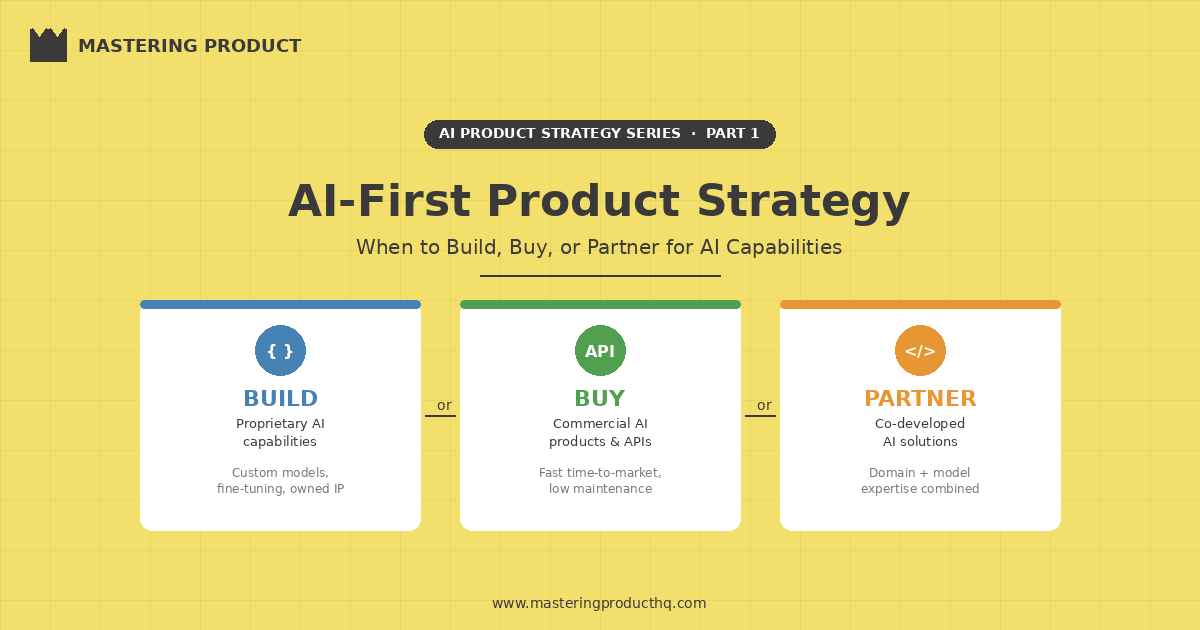
Welcome to this week’s edition of Mastering Product! This is Part 1 of my AI Product Strategy series. Today, I am addressing the question every product leader is facing right now: should you build your own AI capabilities, buy off-the-shelf solutions, or partner with specialized AI providers? The answer isn’t as straightforward as it seems, and getting it wrong can cost your company years of runway. I’ll walk you through a decision framework that cuts through the hype and helps you make this call with confidence. In Part 2, we’ll go deeper into the tactical side of building products on top of LLMs. Let’s get into it.
The AI Capability Question
Every product roadmap in 2026 has some version of “add AI” on it. But behind that deceptively simple line item sits a decision that will shape your product’s competitive position, your team’s capabilities, and your company’s cost structure for years to come.
The real question isn’t whether to incorporate AI, that ship has sailed for most products. The question is how to incorporate it, and the answer depends on factors that most teams don’t evaluate rigorously enough before committing.
I’ve watched companies burn through millions building custom ML infrastructure they didn’t need, while their competitors shipped faster by leveraging third-party APIs. I’ve also seen the reverse: teams that outsourced their core AI capability to a vendor, only to find themselves locked into a commodity experience with no differentiation. Both mistakes stem from the same root cause, making the build/buy/partner decision based on excitement rather than strategy.
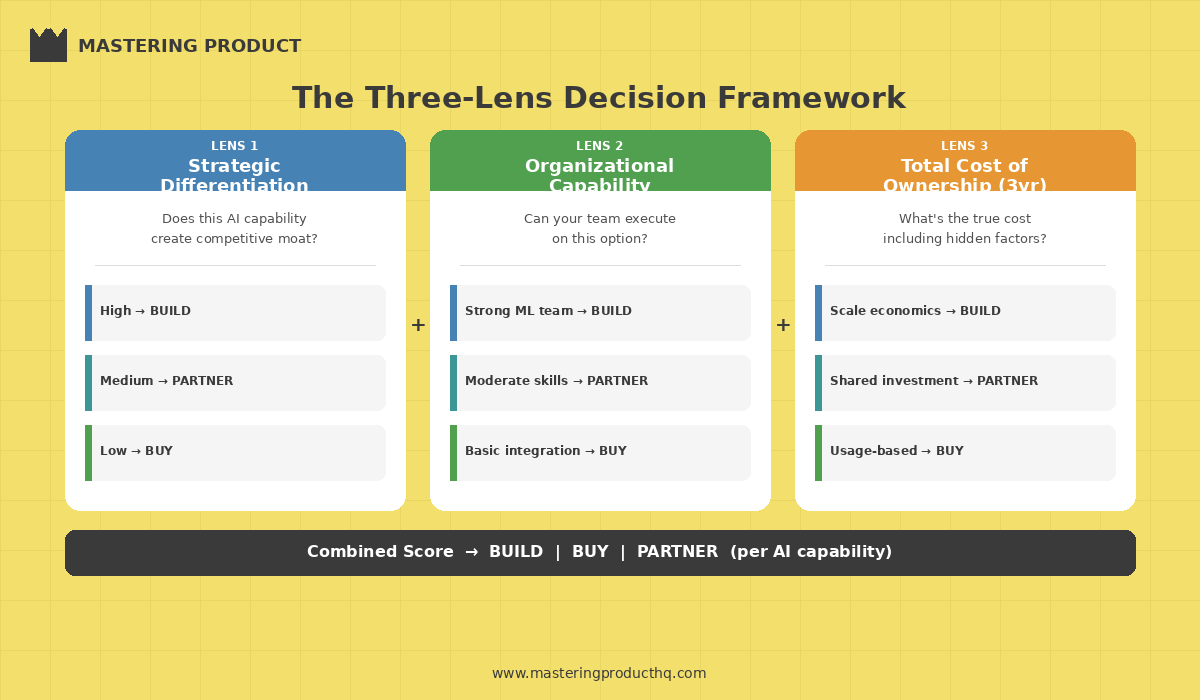
The framework I’m sharing today forces you to evaluate this decision through three lenses: strategic differentiation, organizational capability, and total cost of ownership. Get these three right, and the decision usually becomes clear.
The Build-Buy-Partner Spectrum
Before diving into the framework, let’s be precise about what each option actually means in the AI context:
Build means developing proprietary AI capabilities in-house. This ranges from fine-tuning foundation models on your proprietary data to training custom models from scratch. You own the model, the training pipeline, and the inference infrastructure.
Buy means using commercial AI products or APIs as-is. You’re consuming someone else’s AI capability through their interface, think integrating Anthropic’s API, using a pre-built AI customer service tool, or embedding a third-party recommendation engine. Minimal customization, fast time-to-market.
Partner sits in between. You work with an AI provider to create a solution tailored to your specific use case, often combining their model expertise with your domain data. This could mean working with an AI studio to fine-tune a model on your data, co-developing a solution with a specialized AI company, or establishing deep API integrations with significant customization.
Most real-world AI strategies end up being a blend of all three across different capabilities. The goal isn’t to pick one, it’s to make the right choice for each AI capability in your product.
The Three-Lens Decision Framework
Lens 1: Strategic Differentiation
The first and most important question: does this AI capability create meaningful competitive differentiation for your product?
Not every AI feature needs to be a moat. Some AI capabilities are table stakes, they need to exist, but they don’t define your competitive advantage. Others are core differentiators that, if done well, create compounding advantages over time.
High Differentiation → Build
If the AI capability is central to your value proposition and the quality of that capability directly impacts customer retention and willingness to pay, you should build. Custom-built AI capabilities create three types of moats:
Data moats: Your proprietary data makes the model better than anything a competitor could buy off the shelf
Experience moats: The AI behavior is so deeply integrated into your product’s UX that it can’t be replicated by swapping in a generic API
Feedback loop moats: User interactions continuously improve the model, creating a flywheel that widens your advantage over time
Medium Differentiation → Partner
If the capability matters to your users but the underlying AI technology isn’t your core advantage, your differentiation comes from domain expertise, data, or workflow integration rather than the model itself, then partnering makes sense. You contribute the domain knowledge; the AI partner contributes the model expertise.
Low Differentiation → Buy
If the capability is expected by users but doesn’t influence their choice between you and a competitor, buy it. Internal chatbots, document summarization, basic content generation, spam filtering, these are solved problems. There’s no strategic advantage in building them from scratch.
The Differentiation Test: Ask yourself: ”If a competitor used the exact same AI provider we’re considering, would our product still be meaningfully different?” If yes, buying is fine. If no, you need to build or partner.
Lens 2: Organizational Capability
The second lens is an honest assessment of your team’s ability to execute on each option.
Building AI capabilities requires skills that many product organizations don’t have and that are expensive and time-consuming to develop. Be brutally honest about where your team stands:
| Capability | Build Requires | Buy Requires | Partner Requires |
| ML/AI Engineering | Deep expertise (hiring 6-12 months) | Basic API integration skills | Moderate; ability to collaborate with external ML teams |
| Data Infrastructure | Robust training/serving pipelines | Basic data formatting | Shared data pipelines; governance maturity |
| Domain Expertise | Internal subject matter experts | Ability to evaluate vendor quality | Ability to translate domain knowledge for AI teams |
| Ongoing Investment | Continuous model monitoring, retraining, optimization | Vendor management, cost monitoring | Relationship management, joint roadmap planning |
The Capability Gap Audit: For each AI capability you’re considering, map your current team against these requirements. If you’re more than two major hires away from being able to build, the time cost alone may make building impractical for your current planning horizon.
A modern nuance: AI coding assistants like Cursor, GitHub Copilot, and Claude Code have meaningfully lowered the bar for building AI-powered features. A strong full-stack engineer with good AI tooling can now prototype and ship AI features that previously required a dedicated ML engineer. Factor this into your capability assessment, but don’t overestimate it. Prototyping an AI feature and operating it reliably at scale are very different challenges.
Lens 3: Total Cost of Ownership
The third lens is financial, but it extends well beyond the obvious costs.
Build Costs (Often Underestimated):
Hiring and retaining ML talent (market rates are still 1.5-2x general engineering)
GPU/compute infrastructure for training and inference
Data labeling, cleaning, and pipeline maintenance
Ongoing model monitoring, evaluation, and retraining
Opportunity cost: your engineering team building AI infrastructure instead of product features
Buy Costs (Often Underestimated Differently):
Per-API-call pricing that scales with usage (this can spike dramatically)
Vendor lock-in and switching costs
Limited customization leading to workarounds and technical debt
Dependency on vendor’s roadmap, pricing changes, and reliability
Data privacy and compliance exposure from sending data to third parties
Partner Costs (The Middle Ground):
Initial co-development investment
Ongoing revenue share or licensing
Coordination overhead and slower iteration cycles
Shared IP ownership complexity
Dependency on partner’s viability and priorities
The 3-Year TCO Model: Don’t make this decision based on Year 1 costs alone. Model the total cost over 3 years, including scaling scenarios. API costs that seem cheap at 1,000 daily calls can become prohibitive at 100,000. Conversely, build costs that seem expensive upfront amortize significantly if the capability becomes central to multiple product lines.
The Decision Matrix: Putting It All Together
Here’s how the three lenses combine into a decision:
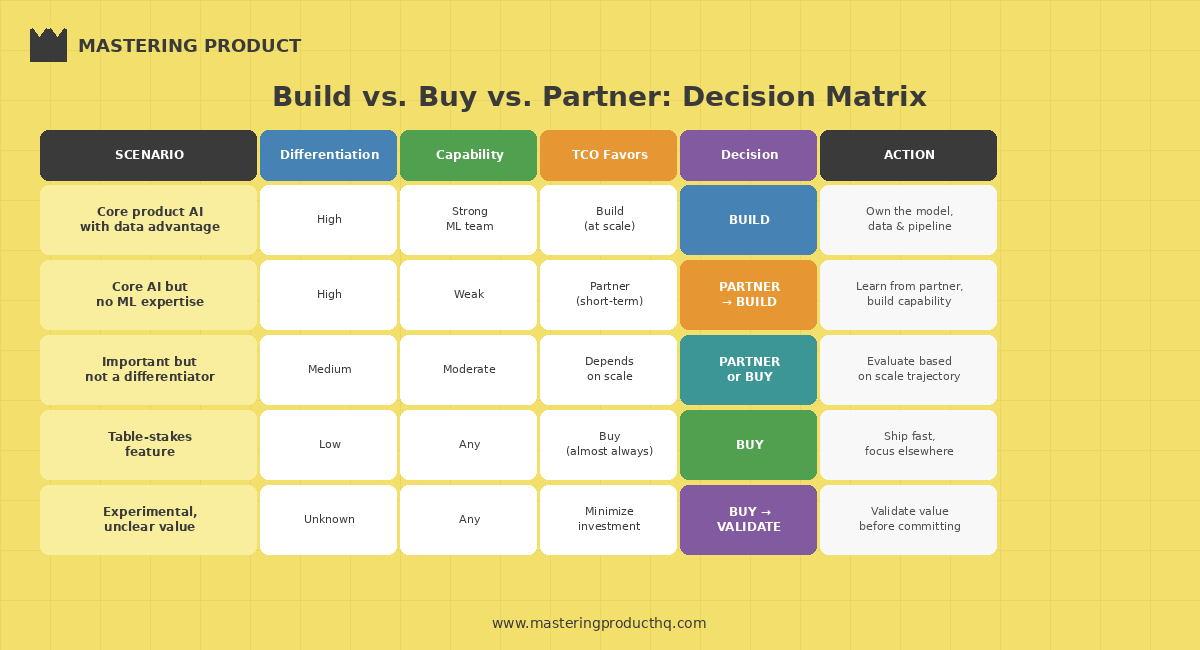
The last row is critical. When the strategic value of an AI capability is unclear, which is more often than teams admit start by buying. Use a third-party API to validate that the capability actually moves your product metrics before investing in building or partnering. This is the Discovery Sprint mindset applied to AI capabilities: validate before you commit.
The AI Capability Portfolio
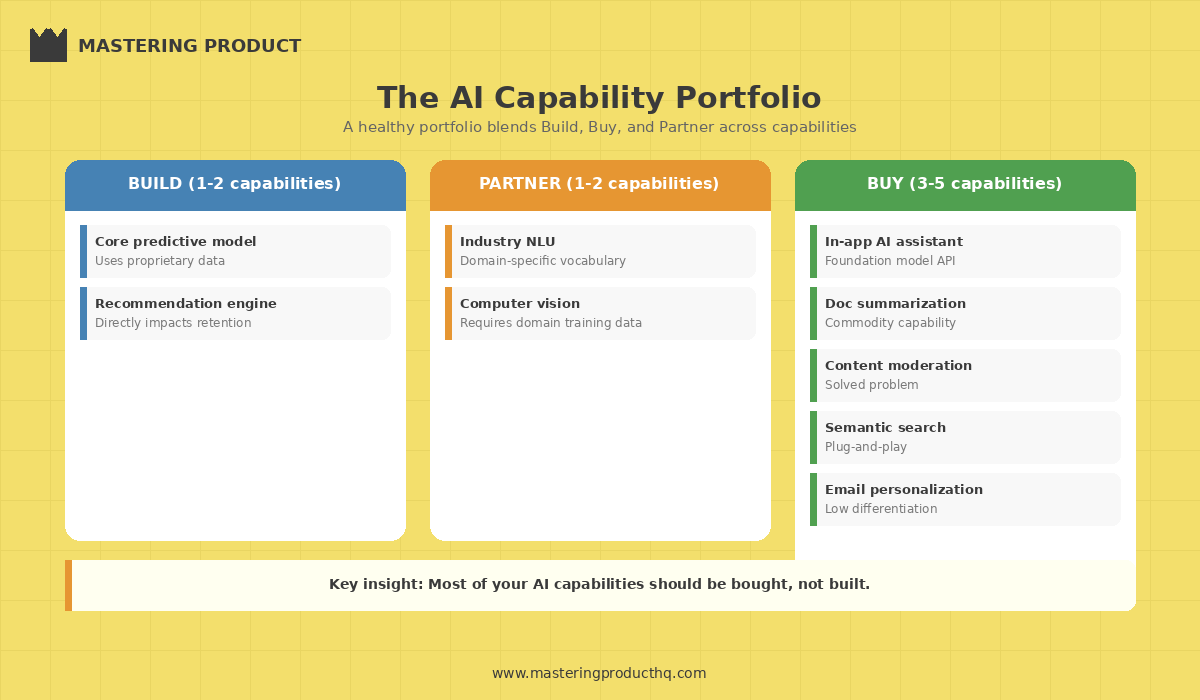
In practice, most products need a portfolio approach, different decisions for different capabilities. Here’s what a healthy AI capability portfolio might look like for a mid-stage B2B SaaS product:
Build (1-2 capabilities):
Your core predictive model that uses proprietary customer data
A recommendation engine whose quality directly impacts retention
Partner (1-2 capabilities):
Natural language understanding tuned to your industry’s vocabulary
Computer vision capability requiring domain-specific training data
Buy (3-5 capabilities):
In-app chat assistant (powered by a foundation model API)
Document summarization and extraction
Content moderation
Search and semantic retrieval
Email and notification personalization
The key insight: most of your AI capabilities should be bought, not built. The buy category should always be the largest. Teams that try to build everything end up building nothing well.
When to Revisit the Decision
The build/buy/partner decision isn’t permanent. Set explicit triggers for revisiting:
Move from Buy to Build when:
The AI capability has proven its strategic value through metrics
API costs are exceeding what a custom solution would cost to operate
You need customization that the vendor can’t or won’t provide
You’ve accumulated proprietary data that would significantly improve a custom model
Move from Build to Buy when:
Maintaining the custom model is consuming disproportionate engineering time
Commercial alternatives have caught up to your custom model’s quality
Your team’s ML talent is being pulled toward more strategic work
The capability has become table stakes in your market
Move from Partner to Build when:
The partnership has validated the strategic importance of the capability
Your team has developed enough ML capability through the partnership to go independent
The partner’s incentives are diverging from yours
Common Mistakes in AI Strategy
1. Building for Ego, Not Strategy
“We should build our own model” often comes from engineering pride rather than strategic analysis. The most sophisticated AI teams in the world, including many at Google, Meta, and Amazon, use third-party models for non-core capabilities. If it’s good enough for them, it’s good enough for you.
2. Ignoring the Speed Advantage of Buying
In a market where AI capabilities are evolving monthly, being 6 months late with a custom-built solution often means being 6 months late to learn what your users actually want. Buy first, learn fast, build later if the data justifies it.
3. Underestimating Vendor Risk
When you buy, you inherit your vendor’s risks: pricing changes, API deprecation, data handling controversies, outages. Mitigate this by maintaining abstraction layers in your codebase. Never hardcode a single AI vendor’s API throughout your product. Use adapter patterns that let you swap providers with minimal refactoring.
4. Treating “AI Strategy” as a One-Time Decision
The AI landscape is shifting faster than any technology wave in recent memory. What was build-worthy 12 months ago may now be available as a commodity API. What was impossible to buy 6 months ago may now be a turnkey solution. Review your AI capability portfolio quarterly.
5. Forgetting About Data Governance
Whichever path you choose, data governance is non-negotiable. Before sending customer data to any external AI provider, evaluate: What data are you sharing? Where is it stored? Who else can access it? Does it comply with your users’ expectations and your regulatory requirements? This isn’t a nice-to-have, it’s a prerequisite.
Getting Started: Your First AI Capability Decision
If you’re making your first significant AI capability decision, here’s a practical starting sequence:
List all AI capabilities on your current or planned roadmap. Be specific, ”add AI” is not a capability. “Generate personalized onboarding recommendations based on user behavior” is.
Score each capability on the differentiation scale (1-5). Be honest about which ones actually drive competitive advantage versus which ones are just expected.
Audit your team’s capability for each item. Do you have the skills to build? To manage a vendor? To collaborate with a partner?
Model the 3-year TCO for your top 2-3 capabilities. Compare build vs. buy vs. partner for each.
Default to buy for anything scoring below 3 on differentiation. Validate first, invest later.
For high-differentiation capabilities, build a 90-day plan that starts with a bought or partnered proof of concept before committing to a full build.
Conclusion: Strategy Before Technology
The most important AI product decision you’ll make isn’t which model to use or which framework to adopt, it’s how you structure your approach to AI capabilities across your product portfolio. Build where it creates lasting differentiation. Partner where you need domain-specific AI but lack the ML expertise. Buy everything else.
The companies winning with AI aren’t the ones building the most models. They’re the ones making the smartest decisions about where to invest their limited resources. In a landscape where foundation model capabilities improve quarterly and new AI tools launch weekly, your competitive advantage increasingly comes not from the AI technology itself, but from how well you integrate it into a product experience your users can’t get elsewhere.
Be strategic. Be honest about your capabilities. And above all, be willing to change your mind as the landscape evolves.
Stay tuned for Part 2 of this series: “The PM’s Guide to Building Products on Top of LLMs” where we’ll go deep on the tactical side of shipping AI-powered features, from prompt engineering to evaluation frameworks to UX patterns that actually work.
How is your team approaching the build vs. buy decision for AI? Leave a comment below.