
Balancing Delivery and Discovery: A Practical Guide for Product Teams Under Pressure
How to maintain discovery practices while meeting delivery expectations, also in regulated environments

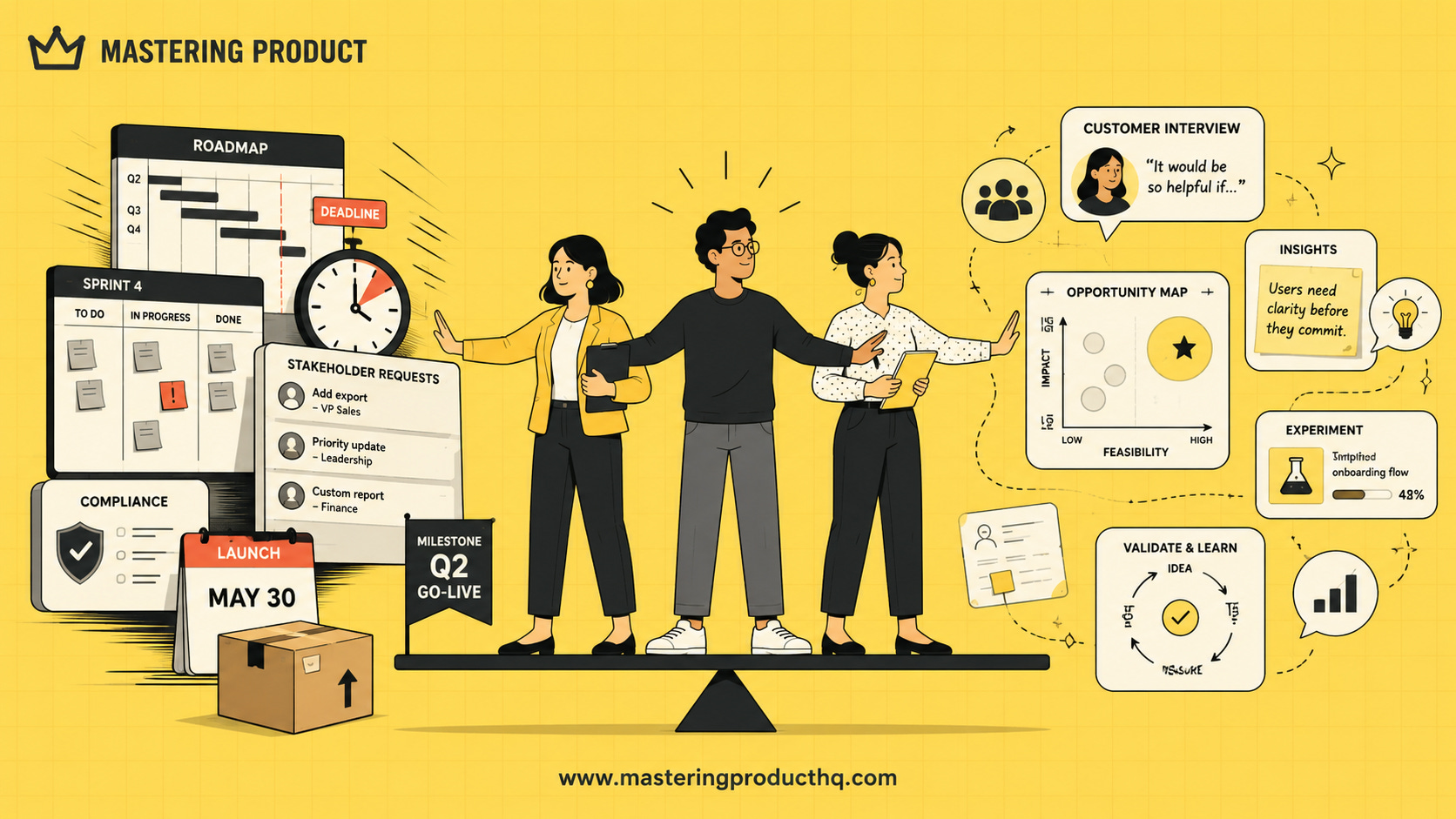
"We need to ship this feature by next month."
"But have we validated this is what customers actually need?"
I hear this conversation play out constantly in product teams. The push to deliver often wins over the need to discover. Your roadmap is packed. Stakeholders are asking for updates. And everyone expects visible progress.
I've faced this exact dilemma throughout my career at 7awi.com, Booking.com, Foodics, and Eneco. And even before them running my gaming startup Wizards Productions. Each company brought different challenges, but the core tension remained the same: how do you make time for proper discovery when delivery pressure is intense?
This gets even trickier in regulated industries, where compliance deadlines add another layer of urgency that can crush discovery practices.
Let me share what's actually worked for me and my teams as we've navigated this balance.
The Delivery-Discovery Dilemma
Before diving into solutions, let's understand why this tension exists:
The Delivery Imperative:
Stakeholders and leadership expect visible progress
Roadmap commitments create delivery deadlines
Regulatory requirements demand timely implementation
Teams feel the need to show value through shipped features
Quarterly OKRs and business goals drive output focus
The Discovery Necessity:
Building without validation leads to wasted effort
Customer needs evolve and require continuous exploration
The most impactful solutions emerge from deep understanding
Reducing risk requires testing assumptions early
Long-term product success depends on continuous learning
When these forces collide, discovery activities often get sacrificed. Teams fall into the trap of building what's requested rather than what's needed. This pattern is particularly common in regulated industries, where compliance requirements often arrive with non-negotiable deadlines.
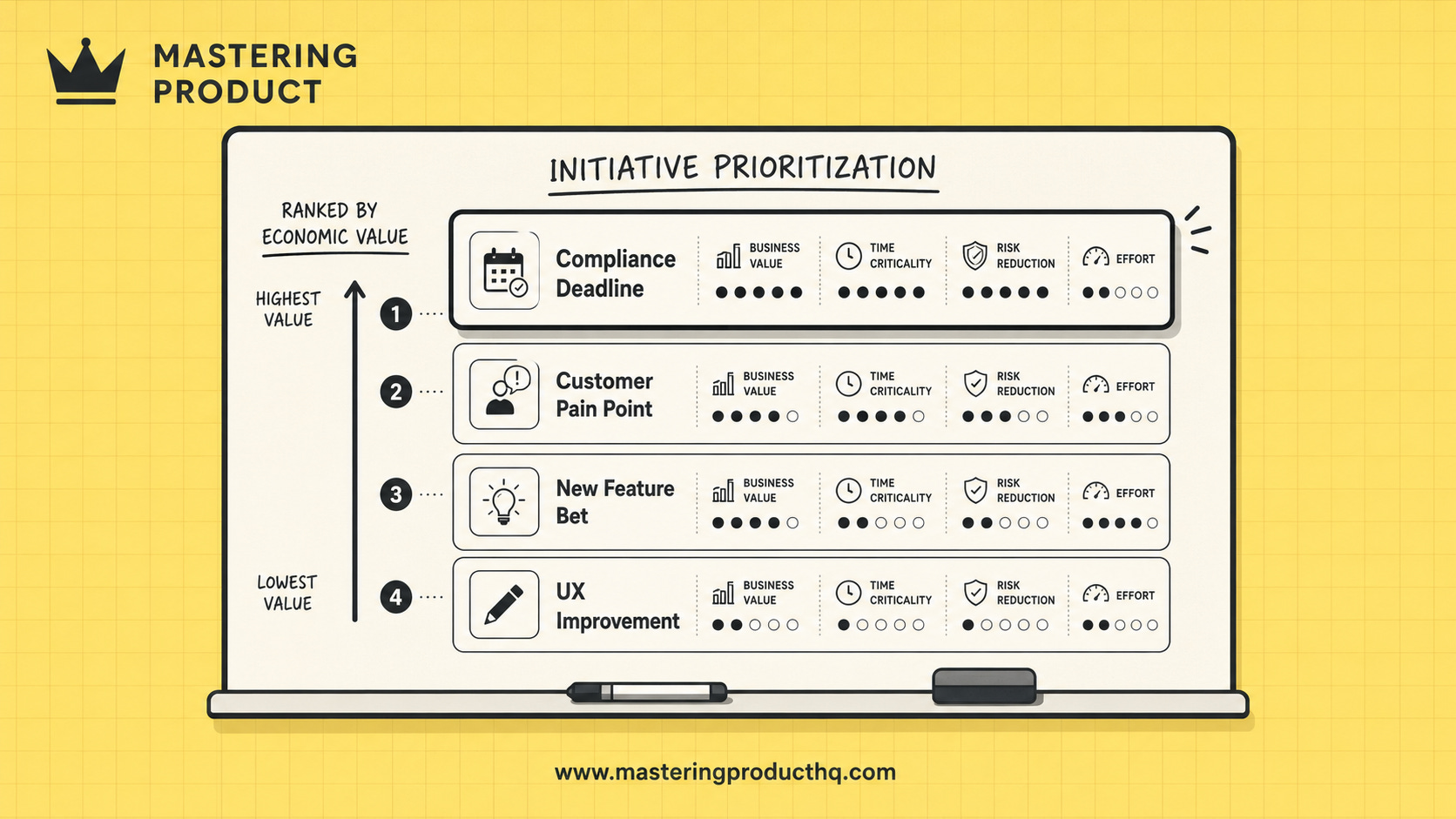
A Framework for Balance: The Cost of Delay
One powerful way to make better decisions about balancing delivery and discovery is to understand the economics of our choices using the Cost of Delay framework. This approach, developed by Don Reinertsen, helps teams quantify the impact of delaying certain decisions or features.
Cost of Delay is the economic impact of delaying a feature or project over time. By calculating this value, teams can make more informed trade-offs between immediate delivery and taking time for discovery.
How to Apply Cost of Delay:
Estimate value over time: For each feature or initiative, estimate the value it would generate per unit of time (week/month) once delivered.
Consider urgency profiles: Different types of work have different urgency profiles:
Fixed date: Regulatory requirements or market events with specific deadlines
Standard: Linear value that accumulates with time
Expedite: Exponential value that could be lost if delayed
Calculate CD3 (Cost of Delay Divided by Duration): This gives you the economic value of prioritizing one item over another.
CD3 = Cost of Delay / Duration
This approach gives you a rational economic basis for deciding when to invest in discovery and when to push for delivery. High CD3 items might warrant more immediate delivery, while other initiatives might benefit from additional discovery to reduce risk or improve outcomes.
Practical Strategies for Maintaining Balance
Now, let's explore specific strategies to maintain this balance in practice:
1. Embed Discovery in Your Delivery Process
Continuous Discovery Habits:
Schedule 1-2 hours each week for customer interviews, regardless of delivery pressure
Make discovery activities non-negotiable calendar items
Rotate team members through customer conversations to build empathy
Opportunity Solution Trees: Map out the problem space visually using Teresa Torres' Opportunity Solution Tree approach:
Start with a clear outcome
Map out customer opportunities (problems, needs, pain points)
Generate multiple solutions for key opportunities
Decide which solutions to experiment with
An example of this was in my time at Booking.com, we implemented "Discovery Wednesdays" where the entire product team dedicated at least half the day to customer conversations, competitive analysis, or data exploration. This created a rhythm that protected discovery time even during high-pressure periods.
2. Leverage Weighted Shortest Job First (WSJF) for Prioritization
WSJF provides a structured way to balance business value, time sensitivity, risk reduction, and effort:
WSJF = (Business Value + Time Criticality + Risk Reduction) / Effort
How to implement it:
Score each factor on a relative scale (1-10)
Calculate the WSJF score for each initiative
Prioritize based on the highest WSJF score
Benefits:
Gives appropriate weight to risk reduction (discovery) activities
Accounts for time-critical regulatory requirements
Provides objective criteria for difficult trade-off decisions
3. Create a "Discovery Buffer" in Your Planning
Just as development teams include buffer time in sprint planning, product teams should allocate explicit discovery buffer:
Fixed Discovery Allocation:
Dedicate 20% of each sprint to discovery activities
Create separate discovery "stories" or tasks in your tracking system
Make discovery visible in sprint planning and reviews
Parallel Tracks:
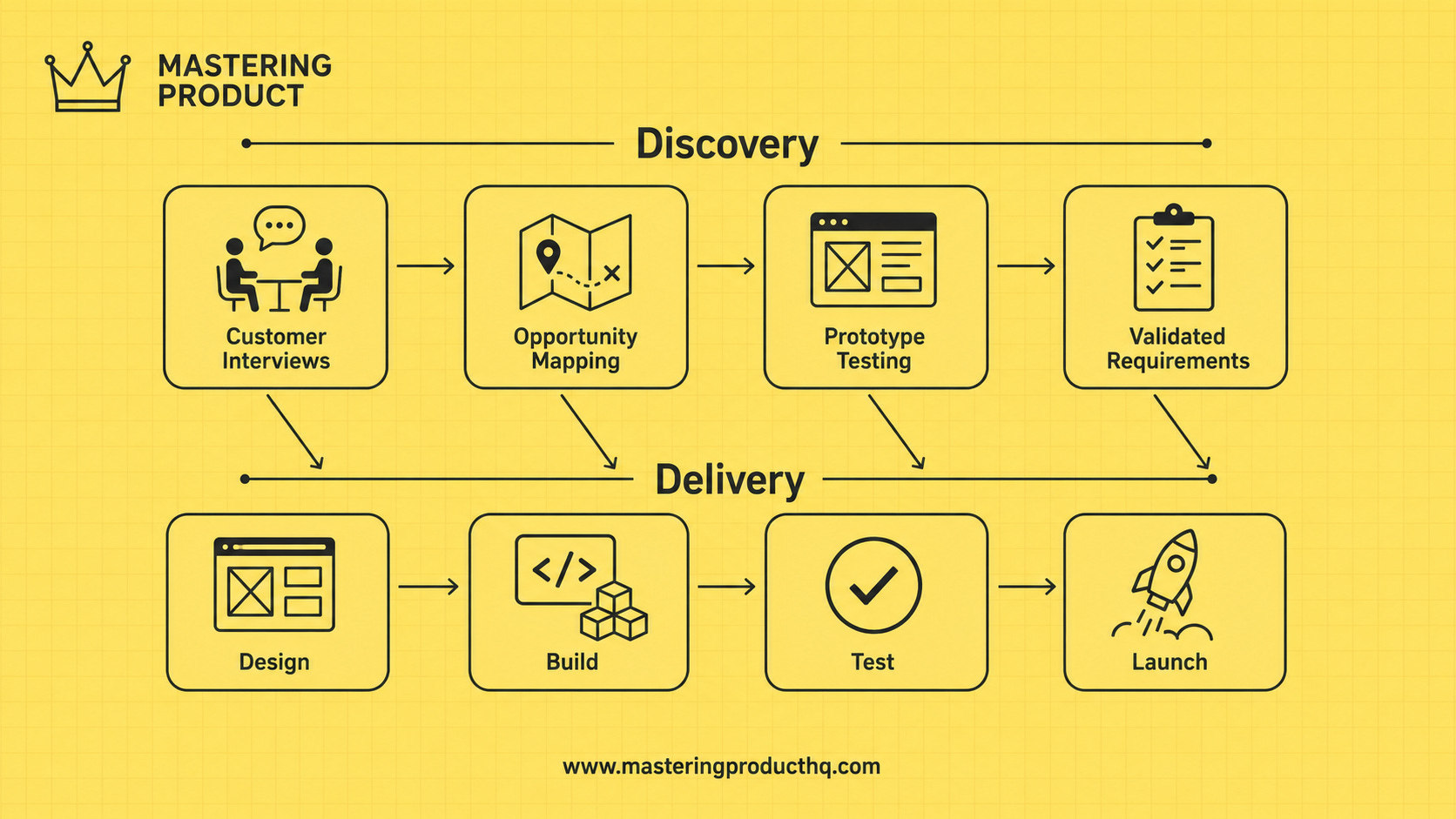
Run delivery and discovery in parallel tracks
While one initiative is being built, the next is being discovered
Maintain a pipeline of validated opportunities
Example: At Eneco, we are implementing a dual-track agile approach where the product team strives to be always one sprint ahead in discovery. This ensured we have validated requirements ready for development teams while maintaining delivery velocity.
4. Right-Size Discovery Based on Risk and Uncertainty
Not all initiatives require the same level of discovery. Adapt your approach based on risk and uncertainty:
High Risk/Uncertainty (New features, new markets):
Comprehensive discovery
Multiple customer interviews
Prototype testing
A/B testing
Medium Risk (Enhancements to existing features):
Focused discovery
Limited customer validation
Data analysis
Low Risk (Bug fixes, compliance changes):
Minimal discovery
Technical validation
By matching discovery effort to risk level, you avoid over-investing in low-risk areas while ensuring adequate discovery for high-risk initiatives.
5. Create Discovery Advocates at the Leadership Level
For discovery to thrive, you need leadership support:
Educate Executives:
Share case studies of both discovery successes and delivery-without-discovery failures
Quantify the cost of building the wrong things
Connect discovery activities to business outcomes
Create Visibility:
Include discovery metrics in executive reporting
Showcase insights from discovery in leadership meetings
Demonstrate how discovery influenced product decisions
Example: At Booking.com, we created a quarterly "Discovery Insights" presentation for leadership that showcased key learnings from our discovery activities and how they influenced our roadmap. This built organizational support for continued discovery investment.
Specific Techniques for Regulated Industries
In highly regulated environments like fintech or energy, the balance becomes even more challenging. Here are techniques specifically for these contexts:
1. Compliance-Driven Discovery
Turn regulatory requirements into discovery opportunities:
Interview customers about their compliance-related needs
Observe how users interact with existing compliance features
Identify opportunities to improve the experience while meeting requirements
2. Parallel Compliance and Experience Tracks
Create separate tracks for regulatory and experience work:
Compliance track focuses on meeting requirements
Experience track focuses on making compliance features user-friendly
Both tracks inform each other
3. "Risk-First" Discovery Approach
Prioritize discovery that reduces regulatory risk:
Focus on areas where non-compliance has the highest consequences
Use discovery to identify edge cases or user confusion points
Build compliance monitoring into feature delivery
Measuring Success
How do you know if you're striking the right balance? Monitor these metrics:
Discovery Health Metrics:
Number of customer interviews per sprint/month
Experiments run per quarter
Assumptions invalidated before development
Ideas killed before significant investment
Delivery Effectiveness Metrics:
Feature adoption rates
Time to value for new features
Reduced rework after launch
Customer satisfaction with new features
A healthy balance should show strong performance across both sets of metrics.
The Reality of Product Management
Let's be honest – there's no silver bullet for the discovery-delivery challenge. In my years working across different regulated industries, I've never found perfect balance, but I've learned that imbalance is where the real danger lies.
When I first joined Booking.com, I was overwhelmed by the delivery pressure. Every team had quarterly targets, stakeholders expected regular releases, and the competition never slept. It was tempting to just build what was asked for. But the teams that thrived weren't the ones that delivered the most features – they were the ones that delivered the right features.
What I've come to believe is that delivery and discovery aren't opposing forces – they're more like breathing in and out. You can't do just one and survive. Sometimes you'll need to lean harder into delivery to meet critical deadlines or compliance requirements. Other times, you'll need to slow down and invest in discovery to ensure you're on the right track.
The trick isn't finding perfect balance – it's developing organizational muscle memory that values both activities. It's creating a culture where skipping discovery feels as wrong as missing a delivery deadline.
In the end, your goal as a product leader isn't to perfectly balance every sprint or to hit some arbitrary ratio of discovery to delivery time. It's to build systems and habits that prevent your team from getting stuck in delivery-only mode – because that's where mediocre products are born.
The most successful product teams I've worked with didn't view discovery as optional – they viewed it as the foundation that makes delivery meaningful. They understood that in the long run, no amount of execution excellence can make up for building the wrong thing.
If you're looking to deepen your understanding of these concepts, I've found these books particularly helpful in my journey:
Continuous Discovery Habits by Teresa Torres
The Principles of Product Development Flow by Donald Reinertsen
Escaping the Build Trap by Melissa Perri
Inspired by Marty Cagan