
Hypothesis-Driven Product Development: A Complete Implementation Guide

Welcome to this week's edition of Mastering Product! Today, we're diving deep into hypothesis-driven product development- an approach that has revolutionized how the most successful product teams operate. Drawing from my experience at Booking.com and Eneco, I'll share a practical framework that has consistently delivered results, along with templates you can implement immediately.
The High Cost of Assumption-Based Product Development
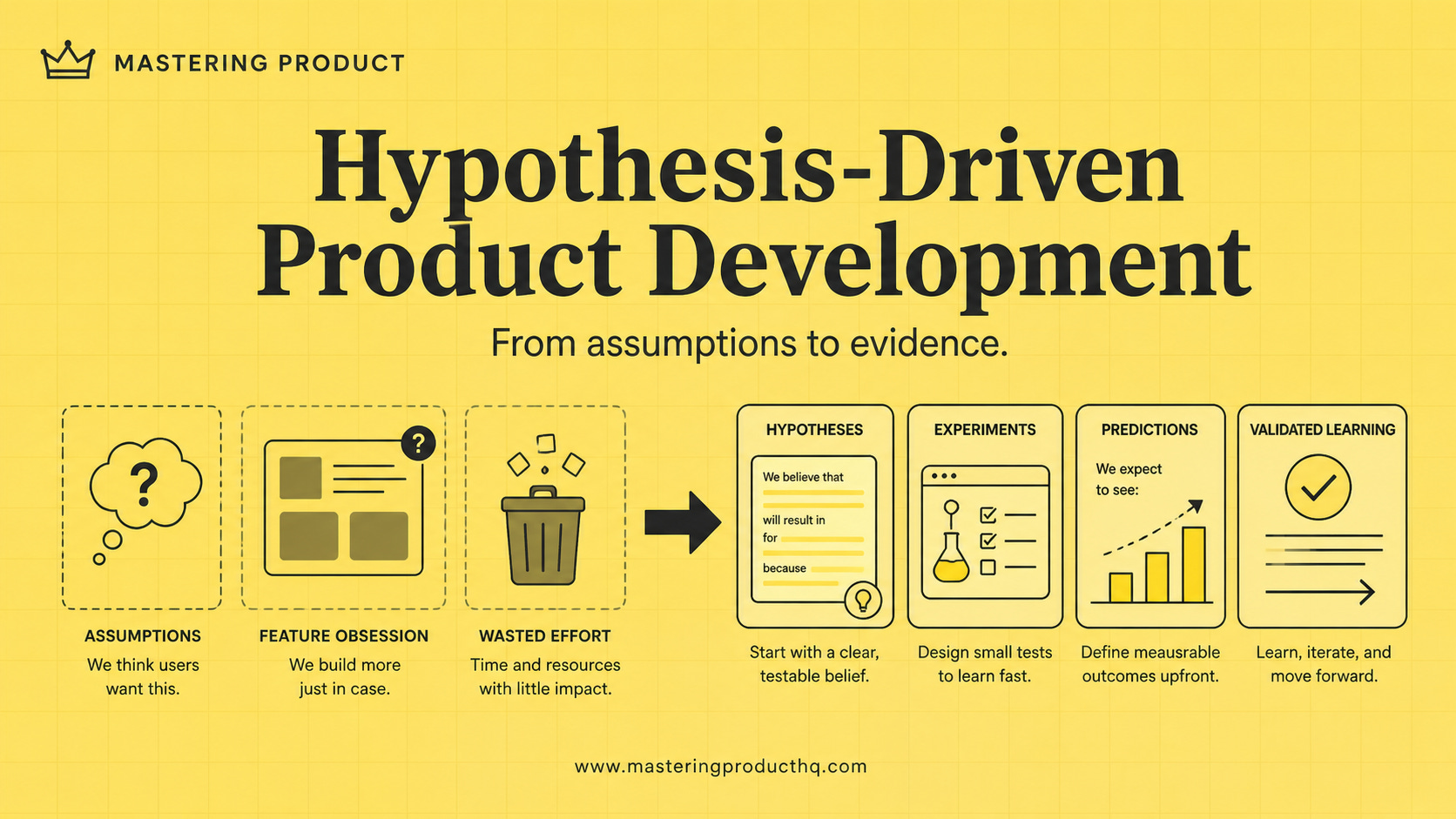
Let's start with a sobering statistic: According to the Product Development and Management Association, 40% of new products fail to deliver their expected ROI. Why? Because traditional product development relies on a dangerous formula:
Untested assumptions + Delayed feedback + Feature obsession = Wasted resources
During my time leading product at Booking.com, I saw millions of euros invested in features that customers never used. At Eneco, entire quarters were spent building functionality that solved problems users didn't actually have.
The root causes of these failures are consistent:
Assumption overload: Requirements based on what we think users want
Delayed validation: Feedback that arrives after significant investment
Output over outcomes: Measuring success by features shipped rather than value delivered
All-or-nothing risk: Addressing all uncertainties at once rather than incrementally
Hypothesis-driven development breaks this cycle by fundamentally changing how we approach product decisions.
The Hypothesis-Driven Mindset: A Transformational Shift
Shifting to hypothesis-driven thinking requires rewiring how product teams think about their work:
Traditional Approach Hypothesis-Driven Approach "We know what users want" "We have informed beliefs about what users might value" "Let's build this feature" "Let's test if this solution addresses a real problem" "Did we ship on time?" "Did we learn what works and what doesn't?" "Success = launching features" "Success = validated learning that drives outcomes"
At its core, this approach treats every product decision as a testable hypothesis. Nothing is assumed; everything is validated through evidence.
The Three Essential Components of Effective Hypotheses
To implement hypothesis-driven development, you need to master three key elements:
1. Problem Hypothesis
A clear problem hypothesis articulates:
Who has the problem (specific user segment)
What the problem is (pain point or job-to-be-done)
Why it matters (impact on users and business)
Example format:
We believe that [user segment] experience [problem] when trying to [achieve goal], which causes [negative impact].
Real-world example from Booking.com:
We believe that business travelers experience frustration when trying to find accommodations that meet their company's policy requirements, which causes them to spend excessive time filtering options and often book out-of-policy stays.
2. Solution Hypothesis
The solution hypothesis specifies:
What solution you propose
How it addresses the problem
What outcomes you expect
Example format:
We believe that by [implementing solution], [user segment] will [expected behavior change], which will result in [business outcome].
Real-world example from Booking.com:
We believe that by implementing a 'Business Travel Mode' with pre-filtered options based on company policies, business travelers will find suitable accommodations 50% faster, which will result in a 15% increase in business bookings and 20% higher compliance with travel policies.
3. Testable Predictions
For each hypothesis, define specific, measurable predictions:
Example format:
If our hypothesis is true, we expect to see [specific, measurable outcome] within [timeframe].
Real-world example from Booking.com:
If our hypothesis is true, we expect to see:
- Average time to booking for business travelers decrease by at least 30%
- Business booking conversion rate increase by at least 10%
- Policy compliance rate increase by at least 15%
- Positive feedback specifically mentioning ease of finding policy-compliant options
The Hypothesis-Driven Development Cycle: A Practical Framework
Implementing hypothesis-driven development follows this four-phase process:
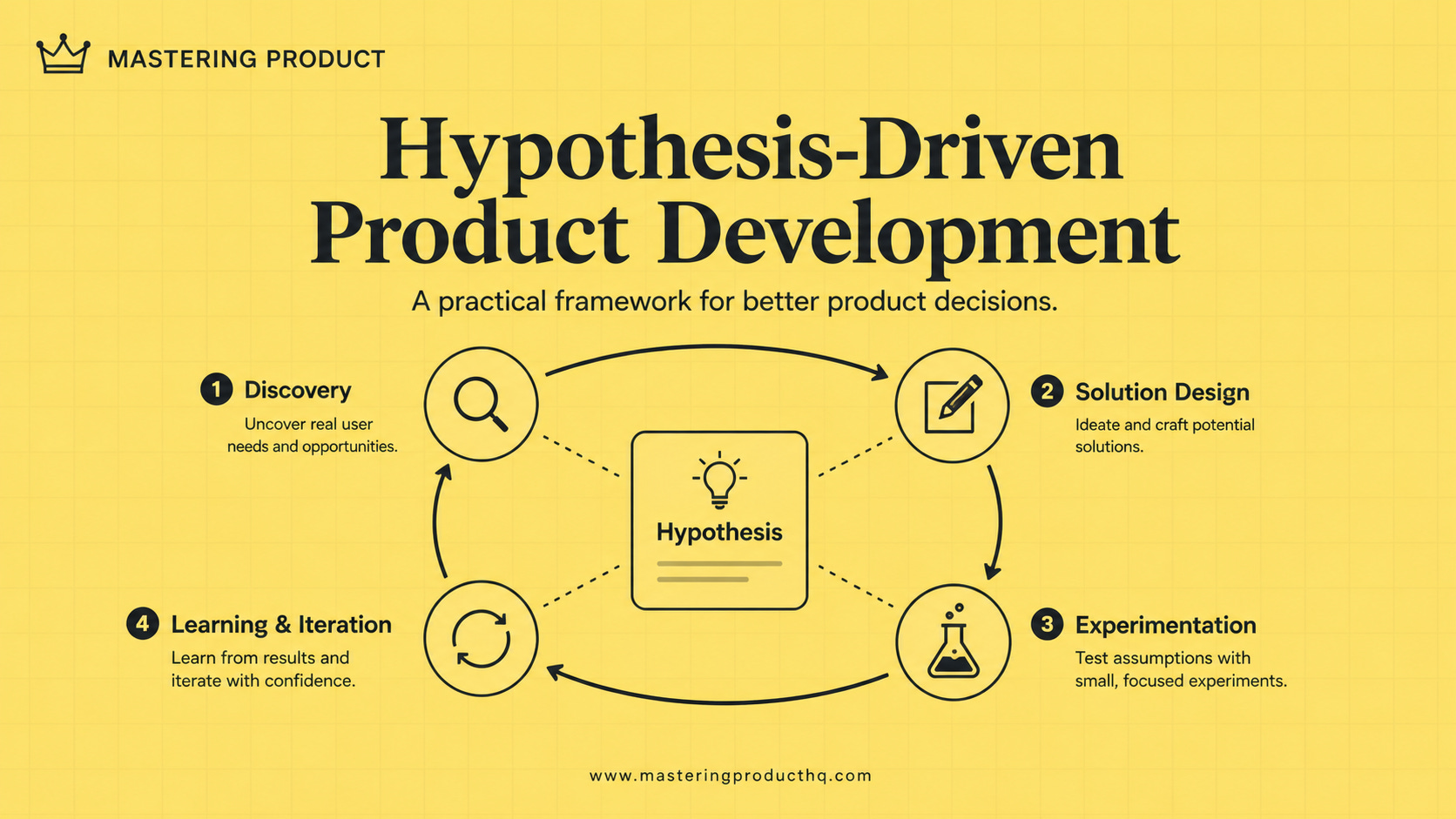
Phase 1: Discovery
Identify opportunities: Use data, user research, and market insights to identify potential problem spaces
Formulate problem hypotheses: Clearly articulate who has what problem and why it matters
Prioritize hypotheses: Focus on problems with the highest potential impact and learning value
Pro tip: Start with analyzing customer support tickets, user session recordings, and analytics data to identify patterns of user friction points.
Phase 2: Solution Design
Develop solution hypotheses: Propose solutions to address the prioritized problems
Define success metrics: Establish clear, measurable indicators of hypothesis validation
Design minimum viable experiments: Create the smallest possible test to validate your hypotheses
Pro tip: Resist the urge to design the "perfect" solution. Instead, ask: "What's the simplest way to test if we're on the right track?"
Phase 3: Experimentation
Build experiment: Develop the minimum viable product or feature to test your hypothesis
Launch and measure: Release your experiment to users and collect data
Analyze results: Evaluate whether the data supports or refutes your hypotheses
Pro tip: The goal isn't to build a perfect feature—it's to validate your hypothesis with the least amount of effort. Consider non-code experiments first, like mockups, prototypes, or even "Wizard of Oz" tests.
Phase 4: Learning and Iteration
Document learnings: Capture insights regardless of whether hypotheses were validated
Share knowledge: Ensure learnings are accessible across the organization
Refine hypotheses: Use insights to refine existing hypotheses or develop new ones
Pro tip: Create a "learning wall" (physical or digital) where teams can share experiment results and insights, fostering a culture of experimentation.
Implementing Hypothesis-Driven Development in Your Organization
Transitioning to hypothesis-driven development requires changes at both team and organizational levels:
Team Level Implementation
1. Hypothesis Formation Workshops
Conduct regular workshops where teams collaboratively develop and refine hypotheses. Structure these sessions to include:
Review of user research and data
Problem hypothesis formulation
Solution hypothesis brainstorming
Prediction definition and success criteria
Workshop Template:
1. Problem Space Exploration (30 minutes)
   - What user problems have we observed?
   - What data supports the existence of these problems?
   - Which user segments are most affected?

2. Problem Hypothesis Formulation (30 minutes)
   - For each potential problem, complete:
     "We believe that [user segment] experience [problem] when trying to [achieve goal], which causes [negative impact]."

3. Solution Hypothesis Development (45 minutes)
   - For each problem hypothesis, complete:
     "We believe that by [implementing solution], [user segment] will [expected behavior change], which will result in [business outcome]."

4. Prediction Definition (30 minutes)
   - For each solution hypothesis, define:
     - What specific metrics will change?
     - By how much?
     - In what timeframe?
     - What qualitative feedback would validate success?

5. Experiment Design (45 minutes)
   - What is the minimum viable experiment to test this hypothesis?
   - What resources are required?
   - What risks need to be mitigated?
   - How will we measure results?
2. Hypothesis Tracking System
Implement a system to track hypotheses throughout their lifecycle. This can be as simple as a shared spreadsheet or as sophisticated as a dedicated tool. Key elements to track:
Hypothesis ID and description
Current status (proposed, in testing, validated, invalidated)
Key metrics and targets
Actual results
Learnings and next steps
3. Experiment Review Meetings
Hold bi-weekly meetings to review experiment results and extract learnings:
Present data against predictions
Discuss whether hypotheses were validated or invalidated
Capture key insights
Determine next steps based on learnings
Organization Level Implementation
1. Outcome-Based Planning
Shift planning processes from feature-based roadmaps to outcome-based roadmaps:
Define clear business and user outcomes
Allow teams to develop hypotheses about how to achieve those outcomes
Measure success by outcomes achieved, not features shipped
2. Learning-Oriented Culture
Foster a culture that values learning over being right:
Celebrate invalidated hypotheses as valuable learning
Share learnings across teams through showcases and documentation
Recognize and reward evidence-based decision making
3. Capability Building
Develop key capabilities across the organization:
Train teams in hypothesis formation and experimental design
Build data literacy to enable hypothesis validation
Develop rapid prototyping skills to enable quick experimentation
Common Pitfalls and How to Avoid Them
1. Hypothesis Formulation Pitfalls
Pitfall: Vague, untestable hypotheses that don't lead to clear experiments.
Solution: Use the SMART framework for hypothesis creation:
Specific: Clearly define the user segment, problem, and proposed solution
Measurable: Include concrete metrics that will validate or invalidate the hypothesis
Achievable: Ensure the hypothesis can be tested with available resources
Relevant: Connect the hypothesis to important user or business outcomes
Time-bound: Specify when you expect to see results
2. Experiment Design Pitfalls
Pitfall: Over-engineered experiments that take too long to deliver learnings.
Solution: Follow the Minimum Viable Experiment (MVE) approach:
What's the smallest experiment that could validate or invalidate your hypothesis?
Can you test with a prototype before building the real thing?
Can you limit the test to a small user segment?
3. Analysis Pitfalls
Pitfall: Confirmation bias leading teams to interpret results in ways that support their existing beliefs.
Solution: Implement structured analysis processes:
Define success criteria before seeing results
Have neutral parties review data and conclusions
Actively look for evidence that contradicts your hypothesis
4. Learning Capture Pitfalls
Pitfall: Learnings get lost or aren't shared across the organization.
Solution: Create a systematic learning repository:
Document all hypotheses and results in a central location
Hold regular knowledge-sharing sessions
Create learning summaries that distill key insights
Case Study: Hypothesis-Driven Development at Eneco
When I was leading product at Eneco.com, we transformed our approach to developing energy management solutions by implementing hypothesis-driven development. Here's how we applied this methodology to create a successful new feature:
Initial Problem Hypothesis
"We believe that residential solar panel owners experience anxiety about whether their investment is performing as expected, which causes them to frequently check multiple systems and still feel uncertain about performance."
Research Validation
Through user interviews and data analysis, we confirmed that:
78% of solar panel owners checked their production data at least 3 times per week
64% expressed uncertainty about whether their system was performing optimally
42% had contacted customer support with concerns about system performance
Solution Hypothesis
"We believe that by implementing a 'Performance Health Score' that compares actual production to expected production (based on weather, panel type, and installation specifics), solar panel owners will feel more confident about their system's performance, which will result in higher satisfaction scores and reduced support contacts."
Minimum Viable Experiment
Rather than building a full feature, we:
Created a simple algorithm to calculate expected vs. actual production
Generated weekly performance reports for a test group of 500 customers
Sent these reports via email for 4 weeks
Measured satisfaction, support contacts, and engagement
Results
The experiment validated our hypothesis:
Customer satisfaction among the test group increased by 26%
Support contacts decreased by 31%
89% of test users reported feeling more confident about their system's performance
Iteration
Based on these learnings, we:
Refined the algorithm to provide daily rather than weekly updates
Integrated the feature directly into our mobile app
Added actionable recommendations when performance was below expectations
The final feature, launched to all customers, resulted in a 22% increase in overall customer satisfaction and a 28% reduction in support costs.
Practical Templates for Hypothesis-Driven Development
To help you implement hypothesis-driven development in your organization, I've created several templates you can adapt to your needs:
1. Hypothesis Formation Template
Problem Hypothesis:
We believe that [user segment] experience [problem] when trying to [achieve goal], which causes [negative impact].

Evidence for this problem:
- [Data point 1]
- [Data point 2]
- [User research insight]

Solution Hypothesis:
We believe that by [implementing solution], [user segment] will [expected behavior change], which will result in [business outcome].

Testable Predictions:
If our hypothesis is true, we expect to see:
- [Metric 1] change by [amount] within [timeframe]
- [Metric 2] change by [amount] within [timeframe]
- [Qualitative feedback] from users
2. Experiment Design Canvas
Hypothesis Summary:
[Brief description of problem and solution hypothesis]

Experiment Goal:
[What specific learning are we seeking?]

Minimum Viable Experiment:
[Description of the smallest possible experiment to test the hypothesis]

User Segment:
[Who will participate in the experiment?]

Success Metrics:
[Quantitative and qualitative measures that will validate or invalidate the hypothesis]

Timeline:
- Experiment build: [dates]
- Experiment launch: [date]
- Data collection: [dates]
- Analysis: [dates]

Resources Required:
[Team members, tools, and other resources needed]

Risks and Mitigations:
[Potential risks and how they'll be addressed]
3. Experiment Results Template
Hypothesis Tested:
[Restate the hypothesis]

Experiment Design:
[Brief description of how the experiment was conducted]

Results:
- [Metric 1]: [Actual result] vs. [Prediction]
- [Metric 2]: [Actual result] vs. [Prediction]
- [Qualitative feedback summary]

Hypothesis Status:
[Validated / Partially Validated / Invalidated]

Key Learnings:
- [Learning 1]
- [Learning 2]
- [Learning 3]

Next Steps:
- [Action 1]
- [Action 2]
- [Action 3]
Key Takeaways: The Competitive Advantage of Hypothesis-Driven Development
Reduce risk through validated learning: Test assumptions early and often to avoid costly mistakes
Accelerate time-to-value: Focus on learning quickly, not building perfectly
Optimize resource allocation: Invest in solutions with proven impact
Build a culture of evidence-based decisions: Rely on data, not opinions
Evolve continuously: Adapt to changing user needs and market conditions
In today's rapidly changing market, the ability to learn and adapt quickly is perhaps the greatest competitive advantage a product team can have. Hypothesis-driven development provides a structured approach to continuous learning that transforms not just your products, but your entire organization.
As you begin implementing hypothesis-driven development, remember that the methodology itself should be treated as a hypothesis: start small, experiment with the approach, measure results, and refine based on what you learn. The journey toward becoming a truly hypothesis-driven organization is itself an exercise in continuous learning and improvement.
How are you implementing hypothesis-driven development in your organization? What challenges have you faced? Reply to this email to share your experience, I read every response and often feature reader insights in future newsletters.
Want to get started with hypothesis-driven development? Download my free Hypothesis Testing Template for a ready-to-use tool to implement with your team.