
Product Debt: The Silent Tax on Your Product's Future
How Feature Sprawl, Inconsistent Patterns, and Forgotten Shortcuts Quietly Erode Your Product From the Inside Out

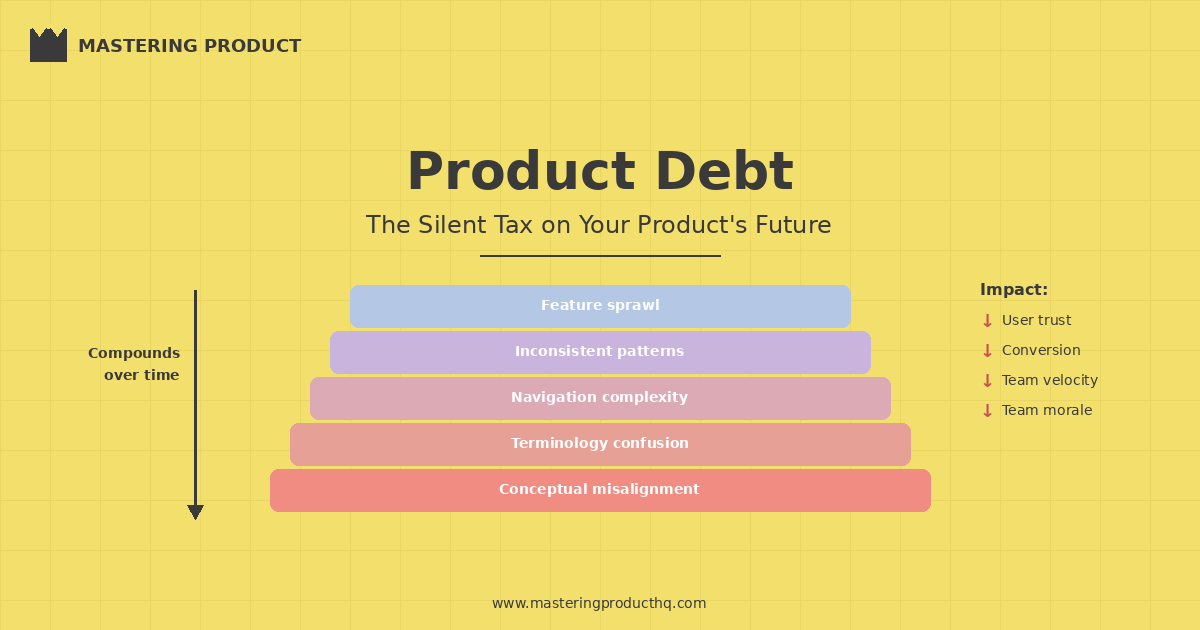
Every product leader knows technical debt, those implementation shortcuts that slow down your engineering team over time.
But there's another form of debt that's just as damaging, and far less discussed: product debt.
Product debt builds up when you make expedient decisions about features, user experience, and product architecture. Each decision feels reasonable at the time. Collectively, they compound into a product that frustrates users, slows your team, and quietly erodes growth.
Left unmanaged, product debt doesn't just slow you down. It eventually makes meaningful progress nearly impossible.
How Product Debt Accumulates
It rarely happens all at once. It builds through a series of individually reasonable choices:
Adding features to address specific requests without a coherent overall vision
Creating new interaction patterns that don't align with existing ones
Using different terms for the same concept across the product
Building deeper navigation as the product expands
Creating workarounds that force users into illogical paths
One day you realise that implementing a seemingly simple change requires untangling dozens of past decisions you barely remember making.
Why Product Debt Is Dangerous
Unlike technical debt, product debt directly impacts your users, not just your team.
It erodes user trust. Users develop mental models of how your product works. Inconsistencies force them to maintain multiple models, increasing cognitive load and reducing confidence in your product.
It creates hidden conversion barriers. Product debt often manifests as friction in critical journeys. These barriers rarely show up as errors in your analytics. They simply cause users to abandon.
It compounds over time. Every new feature built on top of existing product debt inherits and amplifies those inconsistencies. The longer you wait, the more expensive it becomes to fix.
It demoralises product teams. Teams want to build excellent experiences. Being forced to build on a shaky foundation gradually erodes their craft and pride in what they ship.
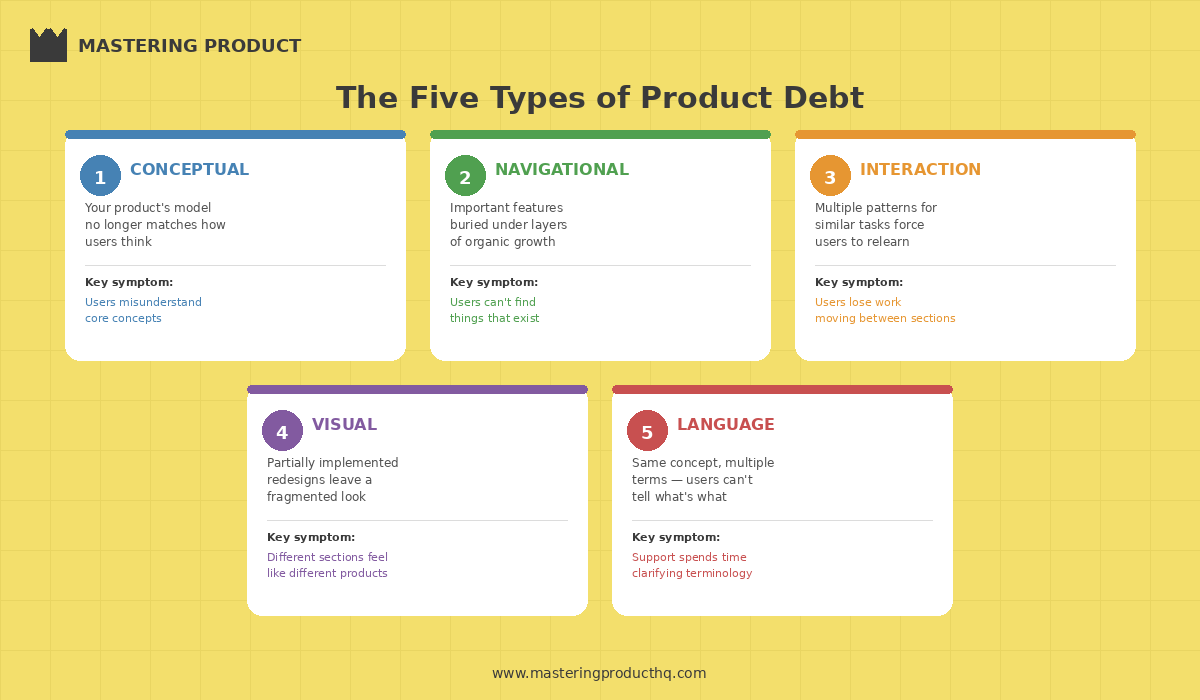
The Five Types of Product Debt
Each type accumulates differently and requires a different approach to fix.
1. Conceptual Debt
This occurs when your product's underlying model no longer matches how users think about the problem.
A classic example: a B2B SaaS platform built around individual users starts acquiring enterprise customers who think in terms of teams, departments, and roles. The product's entire conceptual model, permissions, billing, reporting, was designed for individuals. Retrofitting team-level thinking onto that foundation creates friction everywhere.
Detection signs:
Users consistently misunderstand core concepts
Support frequently explains "how to think about" your product
New features require increasingly complex explanations
2. Navigational Debt
Navigation that grows organically - without intentional redesign - creates labyrinthine paths to important functionality.
Imagine a customer portal where key settings are buried four levels deep, not because they're unimportant, but because the navigation grew one feature at a time. Users contact support asking how to find things that have existed for years.
Detection signs:
Important functionality requires multiple clicks to access
Site search reveals users looking for features that already exist
User journey mapping reveals unnecessarily complex paths
3. Interaction Debt
This builds when your product uses multiple patterns to accomplish similar tasks, forcing users to remember different interaction models for related operations.
A common example: a product where some sections auto-save, others have a persistent save button, and others require a modal confirmation. Users lose work constantly because they assume one model applies everywhere.
Detection signs:
Users frequently lose work or make errors when moving between sections
Training materials must explain multiple ways to perform similar actions
User testing reveals hesitation when users encounter new sections
4. Visual Debt
Multiple rounds of redesigns, each only partially implemented, leave products looking fragmented. Three button styles. Multiple colour schemes. Inconsistent typography.
This matters more than aesthetics. Visual inconsistency signals to users that different parts of the product were built by different people with different standards. It reduces trust — even when the underlying functionality is solid.
Detection signs:
Screenshots from different parts of your product could be from different applications
Design teams spend excessive time debating which existing pattern to follow
User research shows newer sections feel less trustworthy
5. Language Debt
When your product uses "booking," "reservation," and "stay" somewhat interchangeably, users genuinely can't tell if these are the same thing or represent different concepts. Neither can your support team. Neither can new engineers joining the codebase.
Detection signs:
Support frequently clarifies terminology
Internal teams debate what terms actually mean
Localisation becomes increasingly difficult
Measuring Product Debt
You can't manage what you don't measure. Here's how to quantify yours.
Consistency Audit
Create an inventory of your product's patterns and count the inconsistencies:
How many navigation models exist?
How many ways can users perform similar actions?
How many button styles, colour schemes, and typographic systems are in use?
How many terms are used for similar concepts?
Most teams are surprised by what they find. A product that feels manageable often turns out to have 10+ button styles and 7+ navigation patterns once you map them out. That quantification makes the scale of the problem impossible to ignore.
User Journey Friction Analysis
Map your critical user journeys and identify where product debt creates friction:
Count the steps required for key tasks
Identify where users must carry information forward from previous steps
Note where patterns change within a single flow
Mark where users must backtrack to accomplish their goal
Support Request Analysis
Your support tickets tell you exactly where users are struggling. Categorise them by root cause and look for a pattern like this: 25-30% of tickets related to product confusion rather than bugs or missing features. That's product debt showing up in your support costs.
Strategies for Managing Product Debt
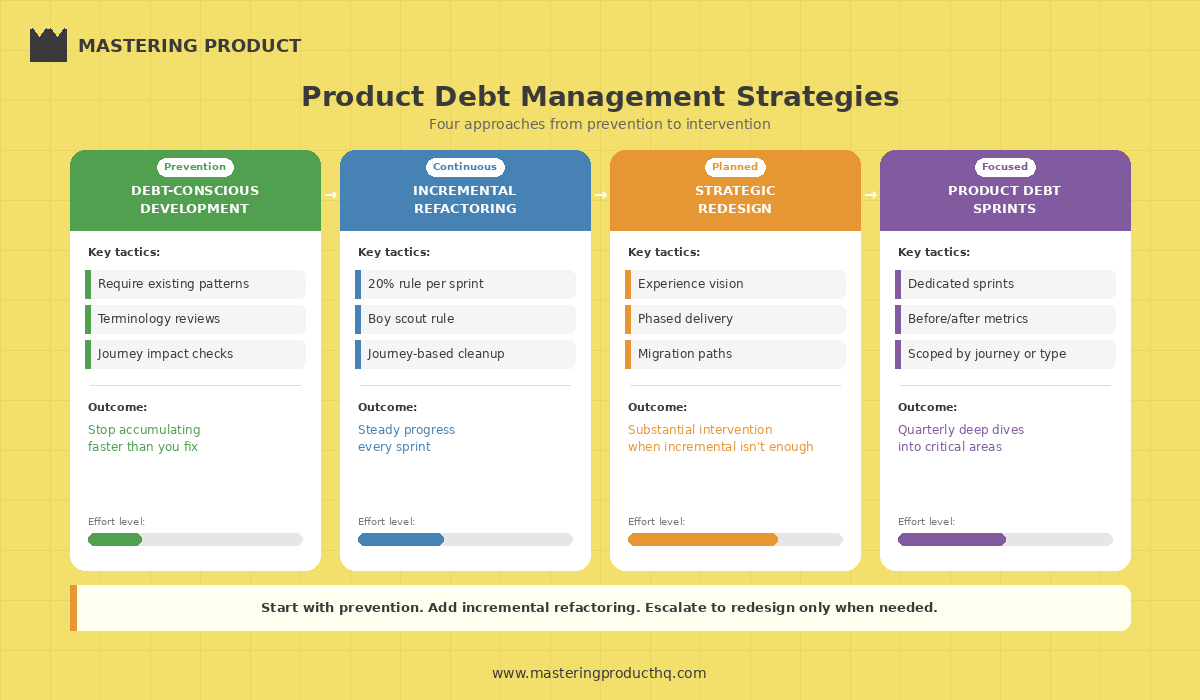
1. Debt-Conscious Development
The fastest way to control product debt is to stop accumulating it faster than you can pay it down.
Require new features to use existing patterns. New patterns need explicit approval and must be added to your design system.
Add a terminology review checkpoint to your development process.
Before approving new features, explicitly evaluate how they affect existing user journeys.
These process changes are lightweight and significantly reduce the rate of new debt accumulation.
2. Incremental Refactoring
You can't fix everything at once. But you can make steady progress:
The 20% rule: Dedicate 20% of each sprint to refactoring product debt in areas you're already working.
The boy scout rule: Leave each area better than you found it. When working on a feature, clean up the surrounding experience.
Journey-based refactoring: Focus on improving entire user journeys rather than isolated features. This creates consistent experiences for complete tasks.
3. Strategic Redesign
Sometimes incremental approaches aren't enough. You need a more substantial intervention:
Create a clear experience vision that addresses your major sources of product debt.
Break it into phases that deliver user value at each stage, rather than a "big bang" redesign.
Design explicit migration paths to move users from old experiences to new ones.
4. Product Debt Sprints
Dedicate focused time specifically to debt reduction:
Schedule sprints focused entirely on product debt in critical areas.
Establish clear before/after metrics.
Limit each sprint to a specific type of debt or a specific user journey.
Quarterly debt sprints not only reduce product debt — they give teams a renewed sense of craft.
What a Debt Paydown Actually Looks Like
Here's a concrete example of what tackling product debt at scale looks like in practice.
Imagine a marketplace product whose detail page, its most critical conversion point, has accumulated five years of experimentation-driven growth:
5 different design patterns for similar information
3 different ways to indicate availability
8 different call-to-action button styles
Inconsistent terminology around item types and conditions
The symptoms are measurable: user research shows confusion, support contacts about key terms have increased 24% year-over-year, and A/B test velocity has slowed because changes frequently conflict with existing patterns.
The approach:
Comprehensive audit mapping every pattern, every terminology inconsistency, every friction point
Conversion impact estimate to secure resources for the work
Pattern rationalisation- one unified set of patterns for key information types
A six-month phased implementation plan, prioritised by user impact
A pattern review process to prevent new inconsistencies from forming
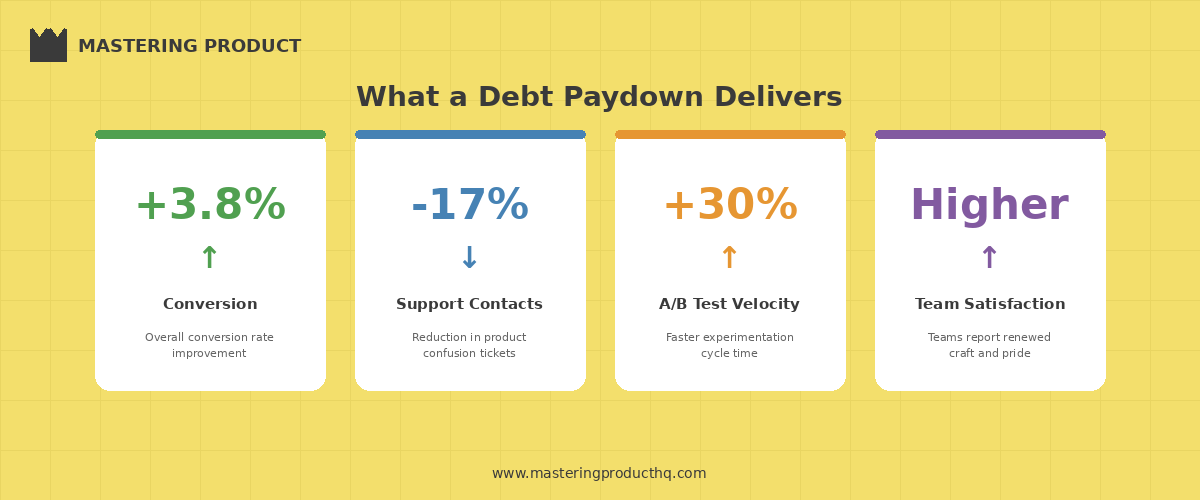
Six months later: conversion up 3.8%, support contacts related to the affected area down 17%, A/B test velocity up 30%, and a product team that reports higher satisfaction in their work.
The outcome isn't just a better product. It's a faster product team with a foundation they can actually build on.
Building a Product Debt-Conscious Culture
Processes and frameworks matter. But culture determines whether they stick.
Celebrate quality, not just ship dates. Add explicit quality metrics to team OKRs, giving them equal weight with delivery metrics.
Make debt visible. Create a debt map that highlights inconsistencies across your product. Make the problem tangible for everyone, not just the design team.
Empower teams to say "not like this." Give product teams the authority to push back when pressured into solutions that create excessive debt. This only works with leadership backing.
Build debt consideration into product reviews. Ask these questions explicitly:
How does this feature integrate with existing patterns?
What terminology does it use, and is it consistent?
How might this create future limitations?
Share the cost. Help stakeholders understand what product debt actually costs in terms they care about: development velocity, support costs, conversion rates, and competitive disadvantage.
The most successful products aren't always the ones with the most features. They're the ones with a coherent vision, consistent execution, and deliberate evolution — products where teams manage debt rather than letting debt manage them.
What product debt is lurking in your product right now? And what's your plan to address it before it starts managing you?