
Product Portfolio Strategy: Optimizing for Growth and Innovation
Why the hardest portfolio decision isn't what to build, but what to stop funding

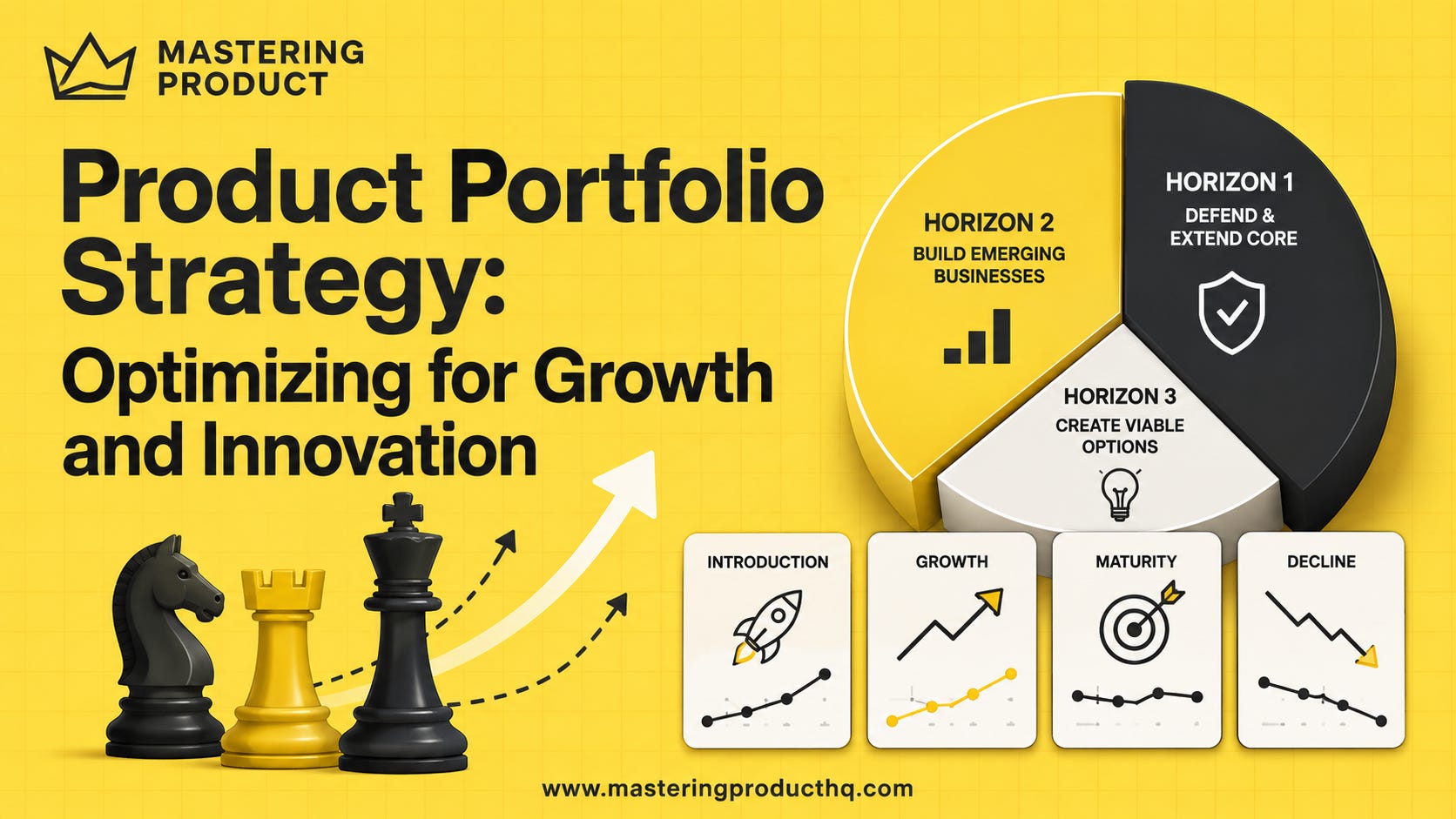
Welcome to this week’s edition of Mastering Product! Most product leaders manage a single product well. Few manage a portfolio well. Today we look at how to allocate resources across products at different lifecycle stages, how to balance core, adjacent, and disruptive bets, how to measure whether your portfolio is healthy, and how to make the hardest call of all: when to sunset a product. Let’s dive in.
The Trap of Managing Products One at a Time
Once your company runs more than one product, your job changes. You stop optimizing a single product and start optimizing a system of products that compete for the same engineers, the same budget, and the same leadership attention.
Most teams never make that shift. They keep treating each product as its own universe. The result is predictable:
The cash-generating core product absorbs most of the resources because its revenue is loudest in every meeting
Newer bets get whatever capacity is left over, which is rarely enough to learn anything useful
Nobody can answer a simple question: where will our growth come from in three years?
You feel productive because every product has a roadmap. You are still vulnerable, because the portfolio as a whole has no strategy.
A portfolio mindset fixes this. It forces you to ask one question across all your products at once: given finite resources, what mix of investments protects today’s revenue while building tomorrow’s?
The Three Horizons Model
The Three Horizons model, popularized by McKinsey, gives you a shared language for that mix. It splits your investments into three groups.
Horizon 1: Defend and extend the core. These are mature products that generate most of your revenue and profit today. The work here is optimization. You improve retention, expand into existing segments, reduce cost to serve, and ship incremental features that protect your position.
Horizon 2: Build emerging businesses. These are adjacent opportunities. They extend a proven capability into a new segment, a new geography, or a new use case. They show real traction but do not yet pay the bills. The work here is scaling what is starting to work.
Horizon 3: Create viable options for the future. These are disruptive bets. New business models, new technology, new markets where you have no proof yet. Most will fail. The few that succeed become your Horizon 1 in five years. The work here is fast, cheap learning, not delivery.
A common starting allocation is 70% of resources to Horizon 1, 20% to Horizon 2, and 10% to Horizon 3. Treat that as a reference point, not a rule.
Here is the nuance most articles skip. Your stage decides your mix.
An early-stage company with one product is almost entirely Horizon 1. It has no portfolio to balance yet. Forcing a 70/20/10 split there is theater.
A mature company with a dominant cash product and no Horizon 3 is the most dangerous case. It looks healthy on every quarterly metric and has no answer when its core market shifts.
A company in a fast-moving market may need closer to 50/30/20, because its Horizon 1 decays faster.
The model is useful because it makes the conversation explicit, not because the percentages are correct.
Map Each Product to Its Lifecycle Stage
The Three Horizons tell you how to think about the future. Lifecycle stage tells you what each individual product needs right now. Before you allocate anything, place every product into one of four stages.
Introduction. The product is live but unproven. The goal is evidence, not scale. You are testing whether the value proposition holds. Investment here should be small, time-boxed, and tied to clear learning milestones.
Growth. The product has product-market fit and demand is accelerating. This is where underinvestment is most expensive. A product growing 80 percent a year that you starve will lose that rate and never get it back. Growth-stage products usually deserve more than their current revenue would justify.
Maturity. Growth has flattened. The product is profitable and stable. The goal shifts from acquisition to efficiency and retention. You want maximum cash with minimum incremental investment, so you can fund the next generation.
Decline. Usage, revenue, or strategic relevance is falling and the trend is structural, not a bad quarter. The goal is to extract remaining value and plan an exit. This is the stage teams refuse to name out loud.
The mistake I have seen most often is funding products by their past, not their stage. A product gets a large budget because it was important three years ago, while a growth-stage product two doors down is rationed because it is still small. You are paying for history instead of trajectory.
A Worked Example of Resource Allocation
Numbers make this concrete. Imagine you run a B2B software company with four products and a team of 100 engineers.
Product A. Mature, 70 percent of revenue, growing 4 percent a year. Horizon 1.
Product B. Growth, 20 percent of revenue, growing 60 percent a year. Horizon 2.
Product C. Introduction, 5 percent of revenue, an early bet in an adjacent market. Horizon 2 leaning Horizon 3.
Product D. Decline, 5 percent of revenue, falling 15 percent a year, losing strategic fit. Horizon 1 in name only.
A naive split allocates engineers by revenue: 70, 20, 5, 5. That is exactly the trap. It pours people into a 4 percent grower and starves a 60 percent grower.
A trajectory-based split looks different:
Product A: 45 engineers. Enough to defend the core, protect retention, and keep the cash engine running. Not enough to over-engineer a product that is barely growing.
Product B: 38 engineers. Deliberately above its revenue share. This is your near-term growth. You fund the trajectory, not the current size.
Product C: 12 engineers. A focused bet with explicit learning milestones at 90 and 180 days. If it fails to hit them, the team is reassigned, not quietly continued.
Product D: 5 engineers. A maintenance crew only, while you plan its sunset. No new features.
The total still adds to 100. The difference is that you moved roughly 25 engineers from defending the past to funding the future, and you did it on purpose, with a rationale you can defend in a board meeting.
This is the core discipline of portfolio strategy. Allocation follows where value is going, not where it has been.
How to Measure Portfolio Health
You cannot manage a portfolio you cannot see. A few metrics tell you whether the system is healthy, separate from how any single product is doing.
Horizon balance. What share of resources sits in each horizon, and does that match your market’s pace? A portfolio with zero Horizon 3 investment is not stable. It is borrowing from the future to look good today.
Revenue concentration. What percentage of revenue comes from your single largest product? Above roughly 70 percent and your portfolio is a single point of failure wearing a portfolio costume.
Growth contribution. Where is new revenue actually coming from? If all your growth comes from one mature product, your Horizon 2 is not working, regardless of how many projects it contains.
Pipeline coverage. If you project current trajectories forward three years, is there enough emerging revenue to replace the natural decay of your core? When the answer is no, you have found your real problem before the market finds it for you.
Investment efficiency by stage. Are you spending heavily on mature products that return little incremental value? This number quietly exposes products funded by their reputation.
Review these as a set, on a fixed cadence, ideally quarterly. The point is not the individual figures. The point is the pattern they reveal when you look at them together.
Sunset Strategies and the Hardest Decision in Product
The hardest portfolio decision is not what to build. It is what to stop. Every product you keep alive past its usefulness taxes everything else through the engineers, support load, and attention it consumes.
Teams avoid the call for human reasons. Someone built it. Customers, even a few, still use it. Killing it feels like admitting failure. So the product survives on life support and the cost stays invisible because it is spread across the rest of the portfolio.
Use clear criteria to decide, so the choice is based on evidence rather than attachment:
Strategic fit. Does the product still support where the company is going? A profitable product that no longer fits the strategy is still a distraction.
Trajectory, not snapshot. Is the decline structural and sustained, or a recoverable dip? One bad quarter is not a sunset signal. Four are.
Opportunity cost. What could the team building or maintaining this product do instead? This is the number that matters most and the one teams measure least.
Cost to serve. What does it actually cost to keep it running once you include support, infrastructure, and the drag it puts on shared systems?
When the evidence says retire it, retire it deliberately. A good sunset protects customers and your reputation:
Decide and set a date. Ambiguity is worse than a hard end. A firm date forces honest planning.
Communicate early and directly. Tell customers before they find out by accident. Be specific about timelines.
Provide a path. Offer a migration to another product, an export, or a recommended alternative. How you end a product is part of your brand.
Reallocate fast. Move the freed-up people and budget to a higher-trajectory part of the portfolio immediately. A sunset that does not free resources for something better was just a loss.
A disciplined sunset is not a failure. It is how a portfolio stays fundable.
Anti-Patterns to Watch For
A few failure modes show up again and again across portfolios:
The all-Horizon-1 portfolio. Every product is mature and optimized. The numbers look excellent right up to the moment the core market moves.
Funding by volume, not voice. Resources follow the loudest stakeholder or the biggest current revenue, never the steepest trajectory.
Zombie products. Products that should have been sunset two years ago, kept alive because no one will make the call, quietly taxing everything else.
Innovation theater. A Horizon 3 portfolio full of projects that are never funded enough to learn anything, so they neither succeed nor get killed.
One mono-process for everything. Treating a disruptive bet with the same delivery process and metrics as a mature cash product. Different horizons need different rules.
If you recognize your own organization in two or more of these, your portfolio does not have a product problem. It has an allocation problem.
Where to Start This Quarter
You do not need a reorganization to begin. You need one honest exercise.
List every product. Assign each one a horizon and a lifecycle stage. Write down what share of your engineering and budget each one consumes today. Then ask three questions.
Does the allocation match the trajectory, or the history? Is there anything in the portfolio that should have been sunset already? If your core decays on its current curve, what replaces it, and is that thing funded enough to matter?
You will not like all the answers. That discomfort is the point. A portfolio strategy is not a framework you adopt once. It is a decision you remake every quarter about where finite resources go, made with evidence instead of inertia.
The companies that compound over a decade are not the ones with the best single product. They are the ones that kept reallocating toward the future before the present forced them to.
---
How does your organization decide what to fund and what to retire? Do you manage products as a portfolio or one roadmap at a time? Reply to this email to share your experience. I read every response and often feature reader insights in future newsletters.