

There’s a career assumption sitting quietly inside most product organisations, and almost nobody says it out loud:
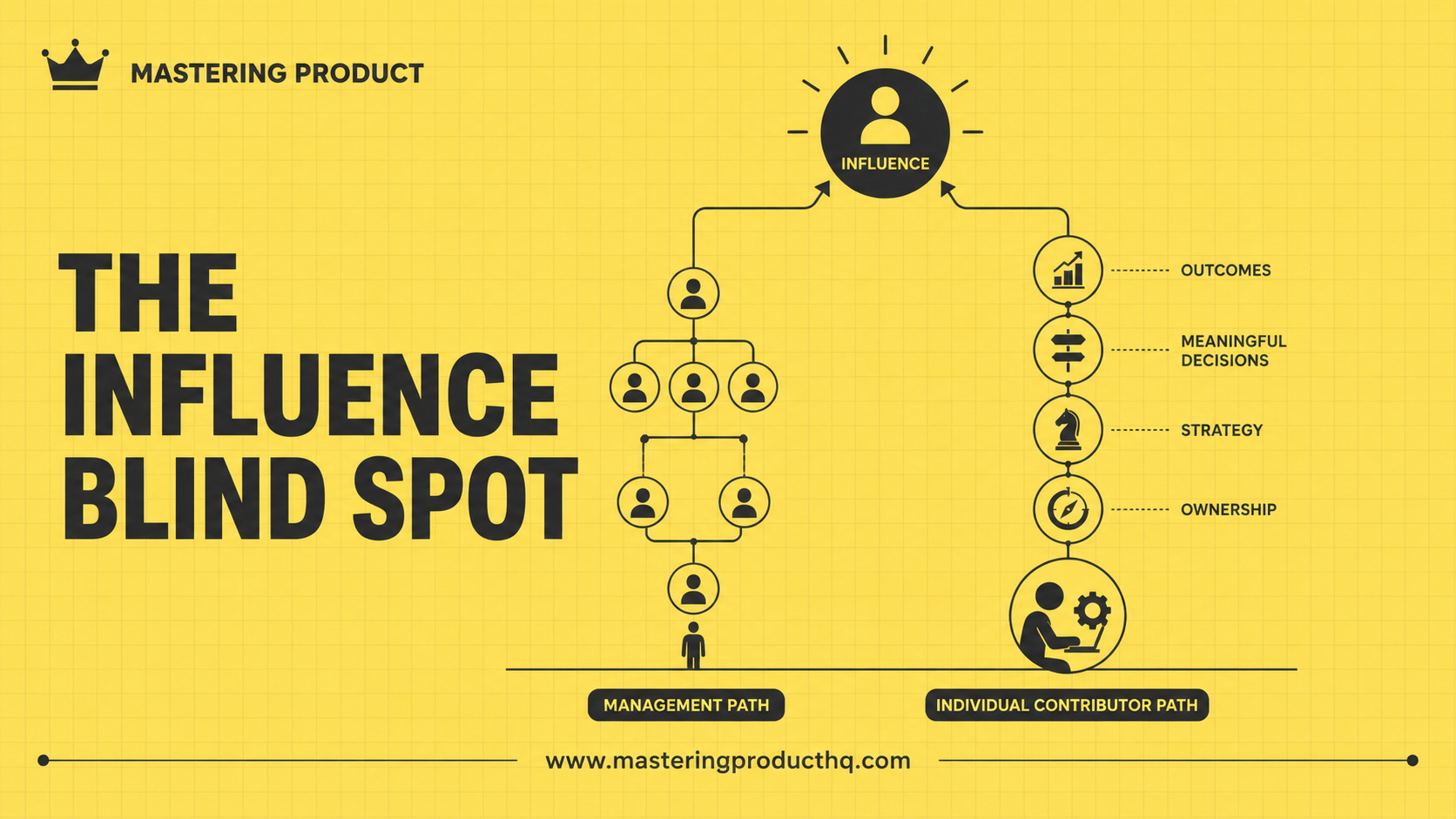
If you want more influence, become a manager.
That one sentence has shaped promotion ladders, compensation bands, leadership programmes, and the way we talk about ambition. Individual contribution gets treated as the craft phase. Management gets treated as the influence phase.
I’ve been on both sides of this. I’ve been the IC who wanted a bigger say. I’ve been the leader who had nothing to offer a brilliant senior IC except a team to run. And I’ve watched good people take that team, hate it, and leave within a year.
In this article I want to unpack what I call the influence blind spot: organisations notice that senior ICs want more influence, then hand them a management job instead of redesigning how influence actually works. I’ll cover what the data says, why influence and authority are not the same thing, the five layers that make an IC role real, and a practical test you can run on your own team this week.
The surprising finding isn’t that people like IC work
Elena Verna recently surveyed 320 people about this, and the mismatch is hard to ignore.
Seventy-one percent said they wanted at least half of their time spent on IC work. Twenty-seven percent wanted to do only IC work. Just 35 people out of 320 wanted to spend all of their time managing. [1]
Now here’s the part that should make every product leader pause. The preference held among current managers too. Fifty-seven percent of managers wanted at least half their time back as an IC. Only 25 out of 128 managers wanted management work exclusively. [1]
Read that again. Most of the people already in the job want less of it.
To be clear, this doesn’t mean management is a bad path. Coaching and mentorship came out as the top benefit of management at 29%, followed by influence over decisions and strategy at 26%, then compensation at 24%. [1] Some people genuinely want to manage. They find meaning in helping others grow, creating clarity, and building something bigger than one person can carry.
The mistake isn’t management. The mistake is turning one valid path into the default definition of ambition.
The downsides people named are just as telling: too many meetings (27%), less hands-on work (25%), and organisational politics (23%). [1] Nobody is running from responsibility. They’re running from calendars.
What people think they’re giving up by staying an IC
This is where it gets interesting.
Compensation was the single most common concern at 32%. Predictable. But when Verna grouped the influence-related answers together, fewer opportunities to influence strategy, less influence over organisational decisions, less opportunity to shape direction, and limited ownership beyond your own area, the total hit 66%. [1]
So the issue isn’t really salary or a shinier title. The fear is much more specific than that:
Being near the centre of the work, but far from the decisions that matter.
I’ve felt that exact thing. It’s the meeting where you’re the person who knows the most about the problem, and you’re the last one asked.
Influence is not the same as authority
Product teams throw the word “influence” around as a compliment when what we usually mean is persuasion.
We tell PMs to influence without authority. We tell staff designers to build alignment. We tell senior engineers to write a proposal and bring stakeholders along. These are real skills and I’d never argue against them. But they are not the whole of influence.
Let me separate the two:
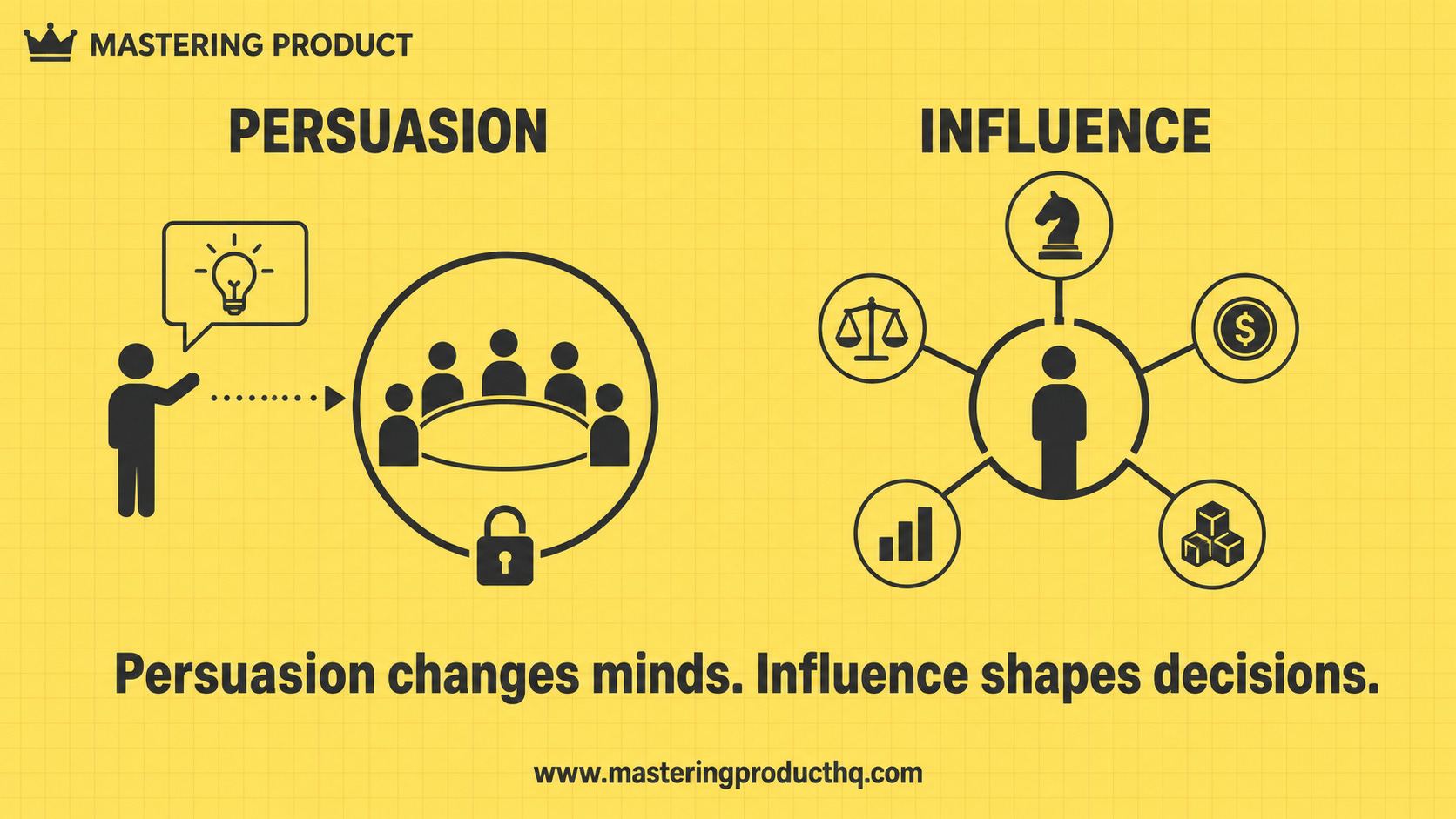
Persuasion is the ability to change someone’s mind.
Influence is the ability to shape what gets considered, decided, funded, built, measured, and stopped.
A senior IC can be world class at persuasion and still have almost no organisational influence. Here’s what that looks like in practice:
They’re invited to comment after the important constraints are already locked.
They own delivery, but not the problem definition.
They have deep expertise, but not the context needed to apply it.
They’re accountable for an outcome while someone else holds every meaningful decision right.
That last one is the killer. That’s how organisations create the appearance of empowerment without transferring any actual power.
I’ve seen both ends of this. At Booking.com, one of the most mature product organisations I’ve worked in, a senior IC could form a hypothesis, design the experiment, run it, and act on the result. Nobody was waiting for permission, because the decision rights were genuinely distributed and the data was open to everyone.
Then I’ve worked in organisations going through transformation, where the same calibre of person was “consulted”. They wrote documents. They were invited to review meetings. They were listened to, sincerely. And every actual call still climbed the ladder. The difference was never talent. It was whether the org had decided in advance which decisions this person was allowed to make.
The five layers of an influential IC role
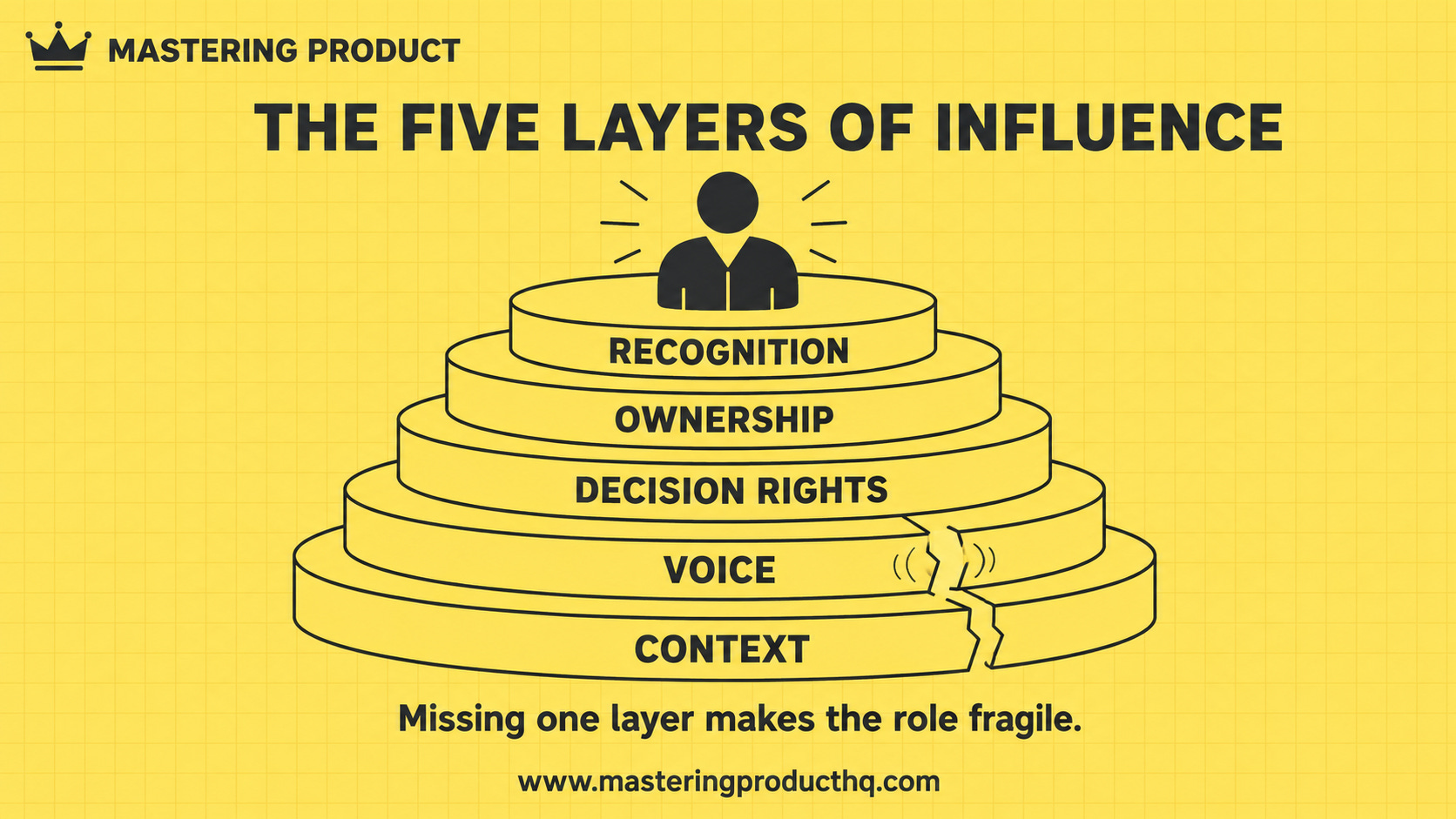
You cannot create an IC career path by changing a title from “senior” to “staff”. I’ve seen companies do exactly that and wonder why nothing changed. The role needs an explicit design for how the person creates and exercises influence.
LayerThe question to answerWhat it looks like in practiceContextDoes this person know enough to make good decisions?Access to strategy, customer evidence, constraints, trade-offs and performance data. Not just a ticket queue.VoiceAre they in the room early enough to shape the problem?Involvement before the roadmap is locked, with a real forum for challenging assumptions.Decision rightsWhich calls can they make without permission?Named authority over a product area, technical direction, research approach or operating decision.OwnershipAre they accountable for an outcome, or just a task?Responsibility from problem framing through solution, launch, learning and iteration.RecognitionDoes the organisation actually reward the impact?Promotion, compensation, visibility and future opportunities tied to value created, not proximity to management.
Miss one layer and the role becomes fragile. I’ve seen each failure mode play out:
Context without decision rights produces well-informed spectators.
Decision rights without context produce dangerous autonomy.
Ownership without recognition produces resentment.
Recognition without ownership produces inflated titles.
The goal here isn’t to hand every senior IC a personal empire. The goal is to make the relationship between judgment, responsibility and impact explicit, so nobody has to guess.
Why do organisations keep missing this?
Three reasons, and I think all three are worth sitting with.
1. Management is structurally convenient. A manager is easy to describe. They have a team, a budget, recurring meetings and a box on the org chart. An IC with broad influence is messier. Their impact crosses functions and their authority attaches to a problem rather than a reporting line. Org charts are bad at drawing that, so we don’t.
2. We confuse information control with leadership. Senior leaders often assume wider access to context creates risk. In my experience the opposite is true. Withholding context creates the bigger risk, because people make local decisions without understanding the system they’re affecting. Verna makes this point directly in her discussion of high-impact ICs, and she defines one plainly: an IC who can take a project all the way through to delivered business value, end to end. [1] You cannot do that from inside a narrow information boundary.
3. We’re more comfortable measuring activity than judgment. A manager can be evaluated on team metrics, hiring outcomes and engagement scores. An influential IC might prevent a bad investment, clarify an ambiguous strategy, simplify a system, or spot an opportunity a quarter before anyone else. All real. None of it shows up cleanly in a quarterly dashboard.
The answer isn’t to make ICs imitate managers. It’s to improve our ability to see and reward consequential judgment.
The senior IC contract
A good IC path is a two-sided contract, and I want to be honest about both sides.
The organisation promises: context, access, decision rights and recognition.
The IC promises: to use that access responsibly. To make decisions rather than escalate them. To surface trade-offs. To own outcomes. To communicate clearly enough that others can act.
This second half matters more than we usually admit. Autonomy without accountability is just isolation with a nicer name. If you want influence, you also have to accept the uncomfortable part of influence: not every decision will be popular, certainty will be rare, and the person closest to the problem often has to choose a direction before the evidence is complete.
The strongest senior ICs I’ve worked with didn’t wait to be granted a bigger title. They found an important problem, built the case for why it mattered, negotiated what they could own, and drew a straight line from insight to measurable impact.
But let’s not put it all on them. Individual initiative cannot compensate forever for a badly designed organisation. If every meaningful decision has to climb the management ladder, you are teaching your best experts that their judgment is advisory and their accountability is real. That’s a deal nobody keeps taking.
A practical test you can run this week
Pick one of your most valuable senior ICs. Answer these five questions honestly:
What important outcome can this person own end to end?
What information do they need to make good decisions that they can’t currently access?
Which decisions can they make today without escalation?
Where are they accountable for results but excluded from the decision?
What evidence would show that their influence is increasing?
Two answers you’re not allowed to accept:
“They’re already in the meetings” is not an answer to question three. Attendance is not decision rights.
“They can make a proposal” is not an answer to question one. A proposal is not ownership.
A strong answer sounds more like this:
“This person owns activation for new teams, from problem framing through experiment design and measurement. They have access to customer research, funnel data and the commercial constraints. They can approve experiments within agreed guardrails, stop work that isn’t moving the outcome, and bring a recommendation to the leadership team when a cross-company trade-off is needed.”
That’s an influence system. It doesn’t require the person to manage anyone. It does require the organisation to trust them with consequential work.
What this means for product leaders
The shift I’d ask you to make is this: stop treating the IC track as a narrower version of management. The tracks should be different, not unequal.
A manager multiplies impact through people, systems and organisational capacity. A senior IC multiplies impact through judgment, craft, leverage and ownership of hard problems. Both are leadership. They just express it through different mechanisms.
The organisations that get this right won’t eliminate management. They’ll make it more honest. People who love coaching will choose it because they want the work, not because it’s the only route to status. People who love building will stay close to the craft without being pushed into a lower-influence lane.
To wrap up, here’s what I’d keep in mind:
Most people, including most managers, want to stay close to the work. That’s not a lack of ambition.
What senior ICs fear losing is influence, not salary. 66% of the concerns were influence-related.
Influence is decision rights and ownership, not persuasion skills.
A real IC path needs all five layers. Missing one breaks it.
Autonomy only works when it comes with accountability.
So the question isn’t whether your senior ICs want a management job.
The better question is: what decisions would they be able to shape if you took their ambition seriously?
That’s where the real career ladder starts.
References
[1] Elena Verna, “Report: What people really think about IC work,” August 13, 2026.
